Ink
Fountain pen inks that do not bleed through
There is no such thing as a bleed-proof ink. There are inks that put down less liquid, and paper that holds what lands on it.
How this page is funded. Buying through a link here earns us a commission at no extra cost to you. It does not change what we recommend or the order we recommend it in, and we have not hands-on tested these products — see how we choose and the full disclosure.
The honest version of this page has to start with a correction. Bleed-through is not a property of the ink alone. It is what happens when more liquid arrives on a sheet of paper than the paper can hold on its surface, and the ink is only one of the three things deciding how much liquid arrives.
The other two are the nib width and the paper. Change the paper and the same ink stops bleeding entirely. Which means the most effective ink for not bleeding is a dry one, and the most effective purchase for not bleeding is a better notebook.
Quick picks
Ranked for the beginner buying their first setup. Every pick names who it is wrong for.
| # | Product | Best for | Price |
|---|---|---|---|
| 1 |  Pelikan 4001 Royal Blue, 62.5 ml A dry-writing classic that lays down less ink than most, which is exactly what cheap paper needs. | Thin, absorbent paper | |
| 2 |  Platinum Carbon Black, 60 ml A true pigment ink: the blackest line you can get out of a fountain pen, and permanent once dry. | Line work and archival notes | |
| 3 | 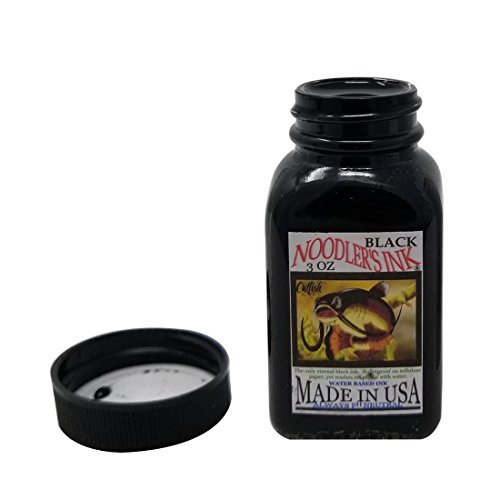 Noodler's Black, 3 oz A dye that bonds to paper fibers, so once it is dry the writing stays put even when the page does not. | Writing that has to survive water | $18.46 · View on Amazon #ad Price as of October 18, 2026. How this is funded |
| 4 |  J. Herbin Perle Noire, 30 ml A dry-writing black in a bottle small enough that a wrong guess costs almost nothing. | A small bottle to try before committing | $15.13 · View on Amazon #ad Price as of October 18, 2026. How this is funded |
1. Thin, absorbent paper
Pelikan 4001 Royal Blue, 62.5 ml
A dry-writing classic that lays down less ink than most, which is exactly what cheap paper needs.
A dry ink is not a defect. Less ink leaving the nib per centimeter of line means less ink for absorbent paper to wick sideways, which is why a dry ink on bad paper often looks sharper than a wet ink on good paper.
4001 is the reference point for that behavior. If you are stuck writing on photocopier paper or a school notebook, this is the pairing that has the best chance of staying crisp.
The trade is on good paper, where a dry ink can feel scratchy and looks thin next to something more saturated.
| Format | 62.5 ml bottleSource: Pelikan 4001 Royal Blue (retail listing, read 2026-09-01) |
|---|---|
| Range | 4001, Pelikan's long-running everyday ink lineSource: Pelikan 4001 Royal Blue (retail listing, read 2026-09-01) |
| Published drying time | Not published |
| Published water resistance | Not published |
What it does well
- Runs dry, which suits thin and absorbent paper
- Large bottle for the money
- Long-established formula that is easy to replace anywhere
What it does not
- Can feel scratchy in an already-dry pen
- Color is pale next to modern saturated inks
- No published figures for drying or water resistance
Skip this if your pen already writes dry — pairing a dry ink with a dry nib is how people conclude they hate fountain pens.
2. Line work and archival notes
Platinum Carbon Black, 60 ml
A true pigment ink: the blackest line you can get out of a fountain pen, and permanent once dry.
Pigment ink suspends solid particles rather than dissolving a dye, which is why it is opaque, why it is permanent, and why it will clog a pen left to dry out.
For drawing, for signatures, and for anything you want legible in twenty years, nothing else in a fountain pen comes close.
It demands discipline. Do not leave it in a pen you are not using, and flush thoroughly when you change ink.
| Format | 60 ml bottleSource: Platinum Carbon Black (retail listing, read 2026-09-01) |
|---|---|
| Type | Pigment ink (carbon), not a dyeSource: Platinum Carbon Black (retail listing, read 2026-09-01) |
| Also sold as | Platinum Carbon cartridges, for pens that take themSource: Platinum Carbon ink cartridges (retail listing, read 2026-09-01) |
| Published drying time | Not published |
What it does well
- Genuinely black and genuinely permanent
- Excellent for ink drawing over watercolor
- Available as cartridges as well as a bottle
What it does not
- Will clog a pen that is left to dry
- Needs more frequent cleaning than any dye ink
- Not a good match for a pen you use once a fortnight
Skip this if your pen sits unused for weeks at a time — a dried pigment ink is a much bigger problem than a dried dye ink.
3. Writing that has to survive water
Noodler's Black, 3 oz
A dye that bonds to paper fibers, so once it is dry the writing stays put even when the page does not.
#ad Price as of October 18, 2026. How this is funded
The reason to keep a bottle of this is not the color. It is that a signed document, an address on an envelope or a note left on a windowsill survives contact with water, which ordinary dye inks do not.
Because the dye bonds to the paper rather than sitting on it, it also tends to feather less on cheap stock than its wetness would suggest.
The trade-off is cleaning. Inks that bond to cellulose also bond to the inside of a pen, so flush more often and do not leave it sitting in a pen you plan to ignore for a month.
| Format | 3 oz bottleSource: Noodler's Black (retail listing, read 2026-09-01) |
|---|---|
| Type | Waterproof once dried; the maker describes the dye as bonding to celluloseSource: Noodler's Black (retail listing, read 2026-09-01) |
| Claimed behavior | Feathering-resistant and quick-dryingThe maker's own claim on the listing. We have not tested it.Source: Noodler's Black (retail listing, read 2026-09-01) |
| Published drying time in seconds | Not published |
What it does well
- Water resistance that ordinary dye inks cannot offer
- Large bottle
- Copes better than most wet inks on ordinary paper
What it does not
- Harder to flush out than a standard dye ink
- Not for a pen you will leave unused for long periods
- No published drying figure despite the quick-drying claim
Skip this if you swap colors often or leave pens inked for weeks — a bonding ink punishes both habits.
4. A small bottle to try before committing
J. Herbin Perle Noire, 30 ml
A dry-writing black in a bottle small enough that a wrong guess costs almost nothing.
#ad Price as of October 18, 2026. How this is funded
Thirty milliliters is a sensible amount of ink for someone with one pen. It is months of writing, and it does not commit you to a color for years.
Perle Noire runs on the dry side for a black, which makes it a better companion for wet nibs and thin paper than most blacks are.
The same ink is available in cartridges, which is unusually convenient if you want to carry the color rather than only use it at a desk.
| Format | 30 ml bottleSource: J. Herbin Perle Noire 30 ml (retail listing, read 2026-09-01) |
|---|---|
| Also sold as | A tin of six international standard cartridgesSource: J. Herbin Perle Noire cartridges (retail listing, read 2026-09-01) |
| Published drying time | Not published |
| Published water resistance | Not published |
What it does well
- Small bottle, small commitment
- Runs dry, which helps on thin paper
- Available in international standard cartridges too
What it does not
- Not water resistant
- Less saturated than a pigment black
- No published figures
Skip this if you want maximum blackness on the page — a pigment ink is a different order of dark.
Why a dry ink helps
Ink flow is capillary: the feed delivers as much ink as the nib can pull away, and a wetter ink flows more freely through the same channels. Less liquid per centimeter of line means less for the paper to absorb, and absorbency is the whole mechanism of bleed-through.
That is why the picks above lead with the dry ones. It is also why the same list overlaps heavily with inks for cheap paper — they are two framings of the same physics.
Why pigment inks behave differently
A pigment ink carries solid particles that are too large to travel far into the paper's fiber structure. The liquid carrier soaks in; the pigment stays near the surface. The practical result is a line that stays sharp on paper where a dye ink would spread — and a permanent one, because the pigment is not going anywhere. Waterproof ink covers that chemistry properly.
The cost is cleaning. Pigment dries hard, so it belongs in a pen you use regularly. How to clean a fountain pen has the routine.
The three-step fix, in order of effect
- Change the paper. Moving from 70 gsm uncoated to 90 gsm coated stops bleed-through with almost any ink. This is by far the biggest single change you can make — see paper GSM explained.
- Change the nib. A Fine puts down noticeably less ink than a Medium; an Extra Fine less again. If you have a swappable nib pen this costs a few dollars.
- Change the ink. Move to a dry ink or a pigment ink. Effective, but the smallest of the three levers.
What will not help
Writing more lightly does very little, because a fountain pen does not depend on pressure. Waiting longer before turning the page prevents smudging but not bleeding. And no ink sold as bleed-proof will save 70 gsm paper under a broad wet nib — the physics does not allow it.
Questions people actually ask
Which fountain pen ink does not bleed through paper?
Dry inks such as Pelikan 4001 and pigment inks such as Platinum Carbon Black bleed least, because both deliver less liquid into the paper. No ink is bleed-proof on thin uncoated paper under a broad nib.
Does the ink or the paper cause bleed-through?
Mostly the paper, then the nib width, then the ink. Changing from 70 gsm uncoated to 90 gsm coated paper stops bleed-through with almost any ink, which no ink change reliably achieves on its own.
Is pigment ink better for not bleeding?
Usually, because its solid particles cannot travel far into the paper fibers. The trade is cleaning: pigment dries hard, so keep it in a pen you use regularly and flush it properly.
Will a finer nib stop bleed-through?
It will reduce it, sometimes decisively. A Fine puts down noticeably less ink than a Medium, and less ink is the entire mechanism. It is the second most effective change after switching paper.