Guides
Paper GSM explained
Grams per square meter is the number everyone quotes and the second most important property of a sheet of paper.
GSM stands for grams per square meter, and it means exactly that: cut one square meter of the paper and weigh it. A 90 gsm sheet is denser or thicker than a 70 gsm sheet of the same material.
It is a useful number and it is over-relied upon, because the property that actually determines bleed-through is how much liquid the paper absorbs, and weight is only a rough proxy for that.
What each band predicts
| GSM | Typical use | With a fountain pen |
|---|---|---|
| 50-60 | Specialist thin paper, airmail stock | Heavy ghosting. Bleeds unless very heavily sized — see the exception below. |
| 70-75 | Ordinary office and school paper, Moleskine Classic | Fine nib and dry ink only. Medium and broad will show through. |
| 80-85 | Better office paper, Japanese notebooks | Workable. Japanese 80 gsm outperforms European 80 gsm noticeably. |
| 90-100 | Clairefontaine, Rhodia, Dingbats | Comfortable with any nib and almost any ink. |
| 120+ | Sketchbooks, art papers | No show-through at all. Usually uncoated, so it takes a wash. |
Where the rule breaks
Tomoe River publishes 52 g/m2 and resists bleeding better than most 70 gsm paper. That single fact disproves the idea that weight predicts performance, and it is worth understanding why.
Bleed-through happens when liquid is absorbed into and through the fiber structure. Tomoe River is sized so heavily that absorption barely occurs at all — the ink sits on the surface and dries there. Weight only predicts bleed-through when it is standing in for 'how much fiber is available to absorb liquid', and hard sizing removes that variable.
Quick picks
Ranked for the beginner buying their first setup. Every pick names who it is wrong for.
| # | Product | Best for | Price |
|---|---|---|---|
| 1 | 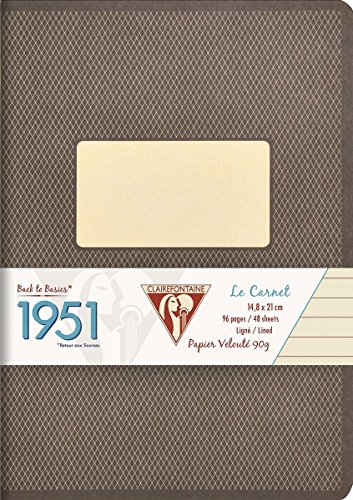 Clairefontaine 1951 A5, lined 90 g/m2 vellum in a stapled softcover, which is the cheapest place to find paper this good. | The best paper per dollar | $9.99 · View on Amazon #ad Price as of October 18, 2026. How this is funded |
| 2 |  Dingbats Wildlife A5, dotted 100 gsm cream paper in a hardcover journal, which is the specification Leuchtturm buyers keep asking for. | Structure plus heavier paper | $22.99 · View on Amazon #ad Price as of October 18, 2026. How this is funded |
| 3 |  Tomoe River FP Notebook A5, dotted 52 g/m2 paper that is half the thickness of copy paper and still resists bleeding, which should not be possible and is. | Ink that shades, sheens and shows off | $11.00 · View on Amazon #ad Price as of October 18, 2026. How this is funded |
1. The best paper per dollar
Clairefontaine 1951 A5, lined
90 g/m2 vellum in a stapled softcover, which is the cheapest place to find paper this good.
#ad Price as of October 18, 2026. How this is funded
This is the paper that makes the case on its own. 90 g/m2 coated vellum is the benchmark the rest of the market is measured against, and here it comes in a stapled book that costs less than a takeout lunch.
The softcover is the compromise. It will not survive being thrown in a bag for a year the way a hardcover will.
If you want to know whether your bleed-through problem is the ink or the paper, buy one of these and write the same page again. The answer is usually immediate.
| Paper weight | 90 g/m2 white velvet vellumSource: Clairefontaine 1951 A5 (retail listing, read 2026-09-01) |
|---|---|
| Maker's claim | Remarkable opacity and strengthThe maker's own wording on its listing.Source: Clairefontaine 1951 A5 (retail listing, read 2026-09-01) |
| Size and extent | 5 3/4" x 8 1/4", 96 pages, linedSource: Clairefontaine 1951 A5 (retail listing, read 2026-09-01) |
| Binding | Staplebound softcoverSource: Clairefontaine 1951 A5 (retail listing, read 2026-09-01) |
What it does well
- Published 90 g/m2 weight at a very low price
- The reference paper for fountain pen use
- Cheap enough to keep several
What it does not
- Softcover, so it wears in a bag
- 96 pages goes quickly
- Slow drying, like all coated paper
Skip this if you need a book that survives daily carry — buy the clothbound version instead.
2. Structure plus heavier paper
Dingbats Wildlife A5, dotted
100 gsm cream paper in a hardcover journal, which is the specification Leuchtturm buyers keep asking for.
#ad Price as of October 18, 2026. How this is funded
100 gsm is the number that removes the argument. At that weight a wet medium nib is comfortable and a broad is workable, which is not true of the 70-80 gsm books this competes against.
The format copies the structured-journal template closely — hardcover, elastic, pocket, ribbon — so you are not trading features for the paper.
Cream paper warms every ink slightly. If you have chosen a color carefully, it will not look the same here as on white.
| Paper weight | 100 gsm, acid-free, creamSource: Dingbats Wildlife A5 (retail listing, read 2026-09-01) |
|---|---|
| Maker's claim | Made for fountain pens, gel ink and markers; outperforms standard 70-80 gsm paperThe maker's own wording on its listing.Source: Dingbats Wildlife A5 (retail listing, read 2026-09-01) |
| Format | A5, dot grid, vegan leather hardcoverSource: Dingbats Wildlife A5 (retail listing, read 2026-09-01) |
| Extras | Inside pocket, elastic closure, bookmarkSource: Dingbats Wildlife A5 (retail listing, read 2026-09-01) |
What it does well
- Published 100 gsm, comfortably above the fountain pen threshold
- All the structured-journal features
- Coated cover survives a bag
What it does not
- Cream paper shifts ink colors
- Heavier and thicker than a comparable 80 gsm book
- Less widely stocked than the market leader
Skip this if you want ink colors to read true — buy a white-paper notebook instead.
3. Ink that shades, sheens and shows off
Tomoe River FP Notebook A5, dotted
52 g/m2 paper that is half the thickness of copy paper and still resists bleeding, which should not be possible and is.
#ad Price as of October 18, 2026. How this is funded
Tomoe River breaks the rule the rest of this page runs on. Weight normally predicts bleed resistance, and at 52 g/m2 this paper should be hopeless. It is not, because it is extremely hard-sized: the ink cannot penetrate, so it sits on top and dries there.
That is also why it shows sheen and shading better than anything else. Ink that stays on the surface pools and dries unevenly, and uneven drying is what shading is.
It is not a general-purpose notebook. The paper is nearly translucent, ghosting is severe by definition, and drying times are long.
| Paper weight | 52 g/m2Source: Tomoe River FP Notebook A5 (retail listing, read 2026-09-01) |
|---|---|
| Maker's claim | Super lightweight at 52 gsm, half the thickness of copy paper, resistant to bleedingThe maker's own wording on its listing.Source: Tomoe River FP Notebook A5 (retail listing, read 2026-09-01) |
| Extent | A5 (5.83" x 8.27"), 160 pages, 80 sheetsSource: Tomoe River FP Notebook A5 (retail listing, read 2026-09-01) |
| Produced by | Sanzen, for Sakae Technical PaperSource: Tomoe River FP Notebook A5 (retail listing, read 2026-09-01) |
What it does well
- Published weight, and an explicit maker claim about bleeding
- Shows ink properties nothing else does
- 160 pages in a book barely thicker than a magazine
What it does not
- Severe ghosting — you will see the other side of every page
- Very slow drying
- Feels alarmingly thin to write on at first
Skip this if you write on both sides of the page, or if you smudge — this is the slowest-drying paper here.
Why Japanese 80 gsm behaves better than European 80 gsm
Same number, different paper. Japanese writing papers are generally made denser and more tightly sized than European office stock at the equivalent weight, which is why an 80 g/m2 Maruman Mnemosyne copes with a fountain pen in a way that 80 gsm copier paper does not.
The practical rule: compare GSM figures within a manufacturing tradition, not across them.
GSM and pounds
American paper is often sold in pounds, and the conversion is not straightforward because the pound figure depends on the sheet size used for the basis weight — the same paper can be quoted as different pound figures depending on whether it is sold as text, bond or cover stock.
Moleskine's own listing gives both for its Classic paper: 70 gsm and 47 lb. Where a maker publishes both, use it; where it publishes only one, we quote the one it published.
What GSM does not tell you
- Drying time. That is coating, and heavier coated paper dries slower, not faster.
- Smoothness. A heavy uncoated sheet can feel rougher than a light coated one.
- Opacity. Related but not the same. Ghosting is opacity; bleeding is absorption.
- Whether the maker published it at all. Several well-regarded notebooks state no figure — the paper hub lists which, and the notebook brand rankings sort the makers by whether they disclose it.
- Whether the number is good enough for your pen. Seventy gsm is the usual dividing line, and the Moleskine question works through what that weight does in practice.
- Where the sheet was made. A Japanese 80 gsm sheet and a European 80 gsm sheet do not behave alike, which is the whole argument of the Japanese notebook roundup.
Questions people actually ask
What GSM paper is best for fountain pens?
90 gsm and above is comfortable with any nib and almost any ink. 80 gsm works with a fine nib, particularly in the Japanese tradition. 70 gsm is thin and will show through with a medium or broad nib.
What does GSM mean on paper?
Grams per square meter: the weight of one square meter of that paper. It is a measure of density and thickness, not of quality or ink resistance.
Is higher GSM always better for fountain pens?
No. Sizing matters more. Tomoe River publishes 52 g/m2 and resists bleeding better than most 70 gsm paper, because it is sized so heavily that ink cannot penetrate the surface.
Why does Japanese 80 gsm paper perform better than European 80 gsm?
Japanese writing papers are typically denser and more tightly sized than European office stock at the same weight. Compare GSM figures within a manufacturing tradition rather than across them.
How do I convert GSM to pounds?
Not reliably, because the pound figure depends on the basis sheet size and differs between text, bond and cover stock. Where a maker publishes both — Moleskine states 70 gsm and 47 lb — use their figures.
Sources
- Clairefontaine 1951 A5 — 90 g/m2 (retail listing, read 2026-09-01)
- Dingbats Wildlife A5 — 100 gsm (retail listing, read 2026-09-01)
- Tomoe River FP Notebook A5 — 52 g/m2 (retail listing, read 2026-09-01)
- Maruman Mnemosyne A5 — 80 g/m2 (retail listing, read 2026-09-01)
- Moleskine Classic — 70 gsm / 47 lb (retail listing, read 2026-09-01)
- ISO 216 paper sizes (A and B series)