Paper
The best notebook brands for fountain pens
Choosing a brand is a bigger decision than choosing a notebook, because a brand is a house paper you will keep coming back to. Here is what each one commits you to.
How this page is funded. Buying through a link here earns us a commission at no extra cost to you. It does not change what we recommend or the order we recommend it in, and we have not hands-on tested these products — see how we choose and the full disclosure.
Most people arrive at this question the wrong way round. They buy one notebook, it works or it does not, and they conclude something about the brand from a sample of one. That is understandable and it is backwards, because the thing a brand actually sells you is consistency: a house paper that behaves the same way in the A5 as it does in the pocket size, this year and in three years.
So the useful question is not which notebook is best. It is which maker you want to be able to reorder from without thinking, and that turns on something surprisingly easy to check - whether the brand tells you what its paper is.
How we ranked these
By what the maker states on its own materials, then by what the range is for, then by price. Criteria before conclusions, because the ranking below only makes sense if you know what it is rewarding.
- Does the brand publish a paper weight? Half of the brands here do not, anywhere we could retrieve. That is not proof of bad paper - two of the best papers on this page are unpublished - but it means you are buying on reputation rather than on specification, and you should know which you are doing.
- Is the range coherent? A good brand answers more than one question. Rhodia in particular runs from a pocket pad to a hardcover journal on the same paper, which is what makes committing to it worthwhile.
- What does the brand lock you in to? Ruling, format and size availability. A brand that only makes lined A5 is a brand you will leave the moment you want dot grid in B6.
- Price, and what changes as it rises. Above a point you stop buying paper and start buying binding, covers and fittings.
- We have not tested any of these papers. This site publishes no hands-on writing tests, here or anywhere. Everything below is published specification, cited, plus the arithmetic on it.
The brands at a glance
| Brand | Publishes a weight? | Best known for |
|---|---|---|
| Clairefontaine | Yes - 90 g/m2 on the books we cover | Coated French paper that holds wet ink at the surface |
| Rhodia | Yes - 90 g on the Goalbook and Webnotebook, 80 g on the No. 16 dot pad | Dot grid, orange pads, and the same paper tradition as Clairefontaine |
| Dingbats | Yes - 100 gsm, acid-free | The heaviest paper of any mainstream journal brand |
| Maruman | Yes - 80 g/m2, and 90 g/m2 on the hardcover dot grid | Spiral books that fold flat, and a lay-flat hardcover range |
| LEUCHTTURM1917 | Yes - 80 g/m2 across the books we cover | Numbered pages, a printed index, and the bullet-journal format |
| Midori | No | Paper designed for writing rather than printing, in plain covers |
| Apica | No | Japanese paper quality at supermarket prices |
| Moleskine | Yes - 70 gsm on the Classic | The format everyone copies, and the paper fountain pens struggle with |
Five publish clearly, two publish nothing, and one publishes a number you will not like. That spread is the honest state of the notebook market, and it is why this page is organized around disclosure rather than around a league table of quality.
The brands
Quick picks
Ranked for the beginner buying their first setup. Every pick names who it is wrong for.
| # | Product | Best for | Price |
|---|---|---|---|
| 1 | 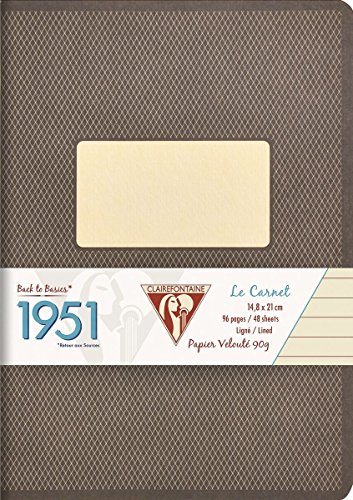 Clairefontaine 1951 A5, lined 90 g/m2 vellum in a stapled softcover, which is the cheapest place to find paper this good. | The best paper per dollar | $9.99 · View on Amazon #ad Price as of October 18, 2026. How this is funded |
| 2 |  Rhodia Webnotebook A5, dot Clairefontaine paper in a hardcover book, which is the shortest route to a journal that a wet nib cannot ruin. | A hardcover journal that holds wet ink | $30.75 · View on Amazon #ad Price as of October 18, 2026. How this is funded |
| 3 |  Midori MD Notebook A5, blank A plain sewn notebook with no cover, no elastic and no branding on the page, made from paper developed specifically for fountain pens. | Writing on paper designed only for writing | $12.80 · View on Amazon #ad Price as of October 18, 2026. How this is funded |
| 4 |  Maruman Mnemosyne A5, ruled Twin-wire bound, 80 g/m2 acid-free Japanese paper, perforated to tear out cleanly. | Meeting notes and work you tear out | $8.95 · View on Amazon #ad Price as of October 18, 2026. How this is funded |
| 5 |  Dingbats Wildlife A5, dotted 100 gsm cream paper in a hardcover journal, which is the specification Leuchtturm buyers keep asking for. | Structure plus heavier paper | $22.99 · View on Amazon #ad Price as of October 18, 2026. How this is funded |
| 6 |  LEUCHTTURM1917 A5, dotted Numbered pages, a printed index and a pocket, in the notebook that made bullet journaling a thing — but at 80 g/m2 the paper sits right at the floor for a wet nib. | Structure, if your ink is well behaved | $31.50 · View on Amazon #ad Price as of October 18, 2026. How this is funded |
| 7 |  Apica Premium C.D. Notebook A5 A plain Japanese school-style notebook whose paper punches far above the cover it comes in. | A cheap notebook that behaves like an expensive one | $11.50 · View on Amazon #ad Price as of October 18, 2026. How this is funded |
| 8 |  Moleskine Classic, large ruled 70 gsm ivory paper — the specification that explains why so many people conclude their new pen is broken. | Everything except a fountain pen | $24.95 · View on Amazon #ad Price as of October 18, 2026. How this is funded |
1. The best paper per dollar
Clairefontaine 1951 A5, lined
90 g/m2 vellum in a stapled softcover, which is the cheapest place to find paper this good.
#ad Price as of October 18, 2026. How this is funded
This is the paper that makes the case on its own. 90 g/m2 coated vellum is the benchmark the rest of the market is measured against, and here it comes in a stapled book that costs less than a takeout lunch.
The softcover is the compromise. It will not survive being thrown in a bag for a year the way a hardcover will.
If you want to know whether your bleed-through problem is the ink or the paper, buy one of these and write the same page again. The answer is usually immediate.
| Paper weight | 90 g/m2 white velvet vellumSource: Clairefontaine 1951 A5 (retail listing, read 2026-09-01) |
|---|---|
| Maker's claim | Remarkable opacity and strengthThe maker's own wording on its listing.Source: Clairefontaine 1951 A5 (retail listing, read 2026-09-01) |
| Size and extent | 5 3/4" x 8 1/4", 96 pages, linedSource: Clairefontaine 1951 A5 (retail listing, read 2026-09-01) |
| Binding | Staplebound softcoverSource: Clairefontaine 1951 A5 (retail listing, read 2026-09-01) |
What it does well
- Published 90 g/m2 weight at a very low price
- The reference paper for fountain pen use
- Cheap enough to keep several
What it does not
- Softcover, so it wears in a bag
- 96 pages goes quickly
- Slow drying, like all coated paper
Skip this if you need a book that survives daily carry — buy the clothbound version instead.
2. A hardcover journal that holds wet ink
Rhodia Webnotebook A5, dot
Clairefontaine paper in a hardcover book, which is the shortest route to a journal that a wet nib cannot ruin.
#ad Price as of October 18, 2026. How this is funded
Rhodia and Clairefontaine are the same group, and the paper is the reason to buy either. It is coated and hard-sized, so ink sits on the surface rather than soaking in — which is what stops feathering before it starts.
A wet ink in a broad nib is the hardest test a notebook faces. This is the book that passes it.
The trade is drying time. Ink that sits on the surface takes noticeably longer to dry, which matters if you are left-handed or in a hurry.
| Size | A5Source: Rhodia Webnotebook A5, dot (retail listing, read 2026-09-01) |
|---|---|
| Ruling | Dot gridSource: Rhodia Webnotebook A5, dot (retail listing, read 2026-09-01) |
| Paper weight | 90 g Ivory Brushed VellumPublished on the listing as of the 2026-10-17 read. It was absent at the 2026-09-01 read, so this row is newer than the rest of the entry.Source: Rhodia A5 Webnotebook, Dot (47391EX) (retail listing, read 2026-10-17) |
| Extent | 96 sheetsSource: Rhodia A5 Webnotebook, Dot (47391EX) (retail listing, read 2026-10-17) |
| Closure and extras | Leatherette cover with an elasticated strap, a ribbon marker and an expanding back pocketSource: Rhodia A5 Webnotebook, Dot (47391EX) (retail listing, read 2026-10-17) |
| Cover | HardcoverSource: Rhodia Webnotebook A5, dot (retail listing, read 2026-09-01) |
What it does well
- Coated paper that resists feathering and bleed-through
- Hardcover, so it survives a bag
- Dot grid is the most flexible ruling
What it does not
- Slow drying, which punishes left-handers
- Expensive per page next to a plain notebook
- Its listing is not in a shipping state at the time of writing
Skip this if you write left-handed and smudge — coated paper is the worst case for drying time.
3. Writing on paper designed only for writing
Midori MD Notebook A5, blank
A plain sewn notebook with no cover, no elastic and no branding on the page, made from paper developed specifically for fountain pens.
#ad Price as of October 18, 2026. How this is funded
MD is the most stripped-back good notebook on this page. No cover, no closure, no logo on the paper: a sewn block of writing paper and a paper wrapper.
It lies completely flat, which sounds trivial until you have fought a hardcover for the bottom two lines of a page.
The blank version is the one to buy if you draw as well as write. Midori sells lined and grid versions of the same paper.
| Paper | MD Paper, developed by the maker as a writing paper resistant to bleeding throughThe maker's own description.Source: Midori, MD Notebook (read 2026-09-01) |
|---|---|
| Size and ruling | A5, unruledSource: Midori MD Notebook A5, unruled (retail listing, read 2026-09-01) |
| Paper weight | Not published |
| Binding | Sewn, lies flatSource: Midori MD Notebook A5, unruled (retail listing, read 2026-09-01) |
What it does well
- Paper developed specifically for writing rather than for printing
- Lies genuinely flat
- No branding anywhere on the page
What it does not
- No weight published
- No cover at all — it needs one if you carry it
- Blank pages are hard work for list-makers
Skip this if you need lines or a cover — buy the ruled version and the MD cover, or buy something hardbound.
4. Meeting notes and work you tear out
Maruman Mnemosyne A5, ruled
Twin-wire bound, 80 g/m2 acid-free Japanese paper, perforated to tear out cleanly.
#ad Price as of October 18, 2026. How this is funded
80 g/m2 is the lower end of what a fountain pen is comfortable on, and Maruman gets away with it because Japanese paper of the same weight is denser and more tightly sized than European office stock. That is why an 80 gsm Japanese notebook can outperform a 90 gsm cheap one.
The spiral binding is the practical part: it folds fully back on itself, so it works on a train or on a knee.
This is a working notebook, not a keepsake. The perforation exists because you are meant to tear pages out.
| Paper weight | 80 g/m2, acid-freeSource: Maruman Mnemosyne A5 (retail listing, read 2026-09-01) |
|---|---|
| Extent | 80 sheets (160 pages), 7 mm college ruledSource: Maruman Mnemosyne A5 (retail listing, read 2026-09-01) |
| Maker's claim | Resists ink bleed-through with minimal ghostingThe maker's own wording on its listing.Source: Maruman Mnemosyne A5 (retail listing, read 2026-09-01) |
| Binding | Twin-wire spiralSource: Maruman Mnemosyne A5 (retail listing, read 2026-09-01) |
What it does well
- Published weight and an explicit bleed claim from the maker
- Folds completely flat and completely back
- Perforated for clean tear-out
What it does not
- Wire binding is bulky in a bag
- 80 gsm is the floor for a wet nib
- Not a book you would keep on a shelf
Skip this if you want a permanent journal — a spiral pad is a working surface that sheds pages by design.
5. Structure plus heavier paper
Dingbats Wildlife A5, dotted
100 gsm cream paper in a hardcover journal, which is the specification Leuchtturm buyers keep asking for.
#ad Price as of October 18, 2026. How this is funded
100 gsm is the number that removes the argument. At that weight a wet medium nib is comfortable and a broad is workable, which is not true of the 70-80 gsm books this competes against.
The format copies the structured-journal template closely — hardcover, elastic, pocket, ribbon — so you are not trading features for the paper.
Cream paper warms every ink slightly. If you have chosen a color carefully, it will not look the same here as on white.
| Paper weight | 100 gsm, acid-free, creamSource: Dingbats Wildlife A5 (retail listing, read 2026-09-01) |
|---|---|
| Maker's claim | Made for fountain pens, gel ink and markers; outperforms standard 70-80 gsm paperThe maker's own wording on its listing.Source: Dingbats Wildlife A5 (retail listing, read 2026-09-01) |
| Format | A5, dot grid, vegan leather hardcoverSource: Dingbats Wildlife A5 (retail listing, read 2026-09-01) |
| Extras | Inside pocket, elastic closure, bookmarkSource: Dingbats Wildlife A5 (retail listing, read 2026-09-01) |
What it does well
- Published 100 gsm, comfortably above the fountain pen threshold
- All the structured-journal features
- Coated cover survives a bag
What it does not
- Cream paper shifts ink colors
- Heavier and thicker than a comparable 80 gsm book
- Less widely stocked than the market leader
Skip this if you want ink colors to read true — buy a white-paper notebook instead.
6. Structure, if your ink is well behaved
LEUCHTTURM1917 A5, dotted
Numbered pages, a printed index and a pocket, in the notebook that made bullet journaling a thing — but at 80 g/m2 the paper sits right at the floor for a wet nib.
#ad Price as of October 18, 2026. How this is funded
The structure is genuinely excellent: numbered pages, an index you fill in yourself, two ribbons and a pocket. Nothing else at this price is as well organized out of the box.
The paper is the argument against, and the listing now puts a number on it: 80 g/m2. That is the lower end of what a fountain pen is comfortable on — adequate for a dry nib, marginal for a wet one.
If you write with a fine nib and a dry ink, this is a fine book. If you have just bought a broad nib and a wet blue, it is the wrong one.
| Extent | 251 numbered pages, A5, dottedThe edition currently listed is the Bauhaus special edition; the format, extent and ruling are the standard Medium A5 dotted hardcover.Source: LEUCHTTURM1917 A5, dotted (retail listing, read 2026-10-10) |
|---|---|
| Maker's claim | Acid-free paper with high ink compatibility, to help prevent bleed-throughThe maker's own wording. It is a comparative claim rather than a measured one, which is why we do not repeat it as a finding.Source: LEUCHTTURM1917 A5, dotted (retail listing, read 2026-10-10) |
| Paper weight | 80 g/m2, acid-freeNow stated on the listing for this edition. 80 g/m2 is the lower end of what a fountain pen is comfortable on.Source: LEUCHTTURM1917 A5, dotted (retail listing, read 2026-10-10) |
| Extras | Blank table of contents, expandable gusseted pocket inside the back cover, two page markers, elastic closure band and eight perforated detachable sheetsSource: LEUCHTTURM1917 A5, dotted (retail listing, read 2026-10-10) |
What it does well
- Numbered pages and printed index
- Hardcover with a pocket and two ribbons
- The most widely stocked structured notebook
What it does not
- 80 g/m2 is the floor for a wet nib
- Thinner paper than the 90 and 100 gsm books on this site
- Costs as much as notebooks with better paper
Skip this if you write with a broad nib or a wet ink — pair the structure you want with paper that can take it.
7. A cheap notebook that behaves like an expensive one
Apica Premium C.D. Notebook A5
A plain Japanese school-style notebook whose paper punches far above the cover it comes in.
#ad Price as of October 18, 2026. How this is funded
Apica does not publish a paper weight, and the notebook still turns up in every conversation about cheap paper that handles fountain pens. That gap between what is published and what is observed is worth being honest about: we can tell you the ruling and the sheet count, and we can tell you the reputation, but not a number.
The build is deliberately plain — a stitched softcover with a paper wrapper.
If the Clairefontaine 1951 is the European answer to good cheap paper, this is the Japanese one.
| Size and ruling | A5, 7 mm ruledSource: Apica Premium C.D. Notebook A5 (retail listing, read 2026-09-01) |
|---|---|
| Extent | 96 sheetsSource: Apica Premium C.D. Notebook A5 (retail listing, read 2026-09-01) |
| Paper weight | Not published |
| Also available | Grid and plain rulings in the same sizeSource: Apica Premium CD Notebook, plain, A5 (retail listing, read 2026-09-01) |
What it does well
- Very cheap for the paper quality it is known for
- Several rulings in the same format
- Thin and light enough to carry two
What it does not
- No published paper weight at all
- Softcover wears quickly
- Plain to the point of anonymous
Skip this if you want a published specification before you buy — Apica does not provide one.
8. Everything except a fountain pen
Moleskine Classic, large ruled
70 gsm ivory paper — the specification that explains why so many people conclude their new pen is broken.
#ad Price as of October 18, 2026. How this is funded
We are including this specifically because it is the notebook most people already own, and because Moleskine publishes the number that explains the problem: 70 gsm.
Seventy grams of uncoated paper is thin. A dry fine nib will be fine on it. A wet medium will ghost badly and a broad will bleed, and the person holding the pen will reasonably conclude the pen is at fault.
Moleskine's own range includes 100, 120 and heavier papers. If you like the object, buy one of those instead of this one.
| Paper weight | 70 gsm, acid-free, ivorySource: Moleskine Classic, large ruled (retail listing, read 2026-09-01) |
|---|---|
| Extent | 192 pages, 5" x 8.25", ruledSource: Moleskine Classic, large ruled (retail listing, read 2026-09-01) |
| Cover | Hard cover with elastic closure and ribbon bookmarkSource: Moleskine Classic, large ruled (retail listing, read 2026-09-01) |
| Also offered | 100, 120, 165 and 200 g/m2 in other Moleskine rangesSource: Moleskine Classic, large ruled (retail listing, read 2026-09-01) |
What it does well
- The maker publishes the weight, which is more than several rivals do
- The physical object is genuinely well made
- Heavier-paper versions exist in the same range
What it does not
- 70 gsm is below what a wet fountain pen needs
- Priced as a premium notebook
- Ivory paper mutes ink colors
Skip this if you are buying it for a fountain pen. This is the paper problem, not the solution.
The two mills behind most of this list
Something worth knowing before you agonize over the top of the ranking: several of these brands are closer to each other than the marketing suggests.
Clairefontaine and Rhodia belong to the same group and share a paper tradition, which is why the Rhodia versus Clairefontaine comparison turns out to be a question about format rather than about paper. If you like one, you will like the other; what differs is whether you want dot grid in a hardcover or lined in a staplebound book.
The Japanese brands are not one thing in the same way, but they share an approach: comparatively thin, densely made, lightly sized paper that takes a fine nib beautifully and dries fast. That is a genuinely different design target from the French coated papers, and the Japanese notebook roundup ranks the individual books on it, and it is the reason a Japanese 80 gsm sheet outperforms a European 80 gsm sheet - a point the paper GSM guide works through properly.
European coated against Japanese uncoated
This is the real fork in the road, and it matters more than which brand you pick within each camp.
| French coated (Clairefontaine, Rhodia) | Japanese (Midori, Apica, Maruman) | |
|---|---|---|
| How ink sits | On the surface. Colors look saturated and shading shows | Slightly into the sheet. Colors read quieter |
| Drying time | Slower, because the ink is not being absorbed | Faster |
| Feathering | Very little, even with a wet nib | Very little, though a broad wet nib will find the limit sooner |
| Feel | Smooth, almost slick under the nib | More texture, more feedback |
| Suits | Broad nibs, wet inks, anyone who wants ink to look its best | Fine nibs, fast writers, left-handers who need short drying times |
Neither is better. If you are left-handed, the Japanese side is the one to start on, because drying time is the variable that decides whether you smudge - the left-handers page explains why premium coated paper makes that problem worse rather than better.
If you have bought an ink you find beautiful, the French side is where it will look beautiful. That is not a small thing, and it is most of the argument for spending more on paper than on the pen.
What the marketing words actually mean
Three phrases turn up on almost every notebook listing, and only one of them is a specification.
- Acid-free is real and checkable. It means the sheet will not yellow and go brittle over decades. It tells you nothing whatsoever about bleed-through, which is what most people think it means.
- Ink-proof is a claim, not a measurement. LEUCHTTURM1917 uses it. There is no standard behind it and no test result attached, so treat it as marketing until a weight appears next to it.
- Bleed-resistant is the same, with the same absence of anything to check.
The only phrase on a notebook cover that constrains the maker is a number in grams per square meter. Everything else is a promise. That is the whole reason this page is ranked the way it is.
Brands this page does not cover, and why
Being straight about the gaps is more useful than pretending the list is exhaustive.
Several well-regarded brands publish no paper specification we could retrieve and are not in the product registry behind this site, so they do not appear above. That is a statement about what we could source, not a judgment on the paper. The same applies to boutique and small-batch makers whose stock moves in and out of availability faster than a page like this can honestly track.
Two names do come up often enough to address directly. Tomoe River is a paper rather than a notebook brand, and it is genuinely exceptional - 52 g/m2 that resists bleeding in a way its weight should not allow. It has its own paper profile because it deserves the explanation. Field Notes publishes 90 gsm and names the mill, which is better disclosure than most of this page manages, but it makes pocket memo books rather than a general range - it leads the pocket notebook roundup instead.
Picking a brand for the pen you own
The decision gets much easier once you work backwards from what is already in your hand.
| If you write with | Start with | Because |
|---|---|---|
| A fine or extra-fine Japanese nib | Apica, Midori or Maruman | Fine nibs put down little ink, so you get the texture and the fast drying without finding the paper's limit. |
| A medium or broad nib, or a wet ink | Clairefontaine or Rhodia | Coated 90 gsm is the reliable answer to a lot of liquid arriving at once. |
| A very wet nib, or shimmer ink | Dingbats | 100 gsm published is the most headroom available in a mainstream journal. |
| Whatever came with the pen, and you want numbered pages | LEUCHTTURM1917 | Nothing else in this list has the index-and-numbering system built in, and the comparison with Rhodia covers the trade. |
| A pencil or a ballpoint, mostly | Moleskine | The objection to it disappears entirely, and the construction is genuinely good. |
How much brand loyalty is actually worth
Less than the brands would like, and more than nothing.
What you get from sticking with one maker is that the paper stops being a variable. When a pen misbehaves you know it is the pen, because the paper has been the same for a year. That is genuinely valuable, and it is the argument for choosing a brand rather than buying whatever is on offer.
What you do not get is a guarantee across ranges. Moleskine's Classic is 70 gsm while its own range runs up to 200 g/m2, and LEUCHTTURM1917 publishes a weight on one size and not another. A brand is a strong prior, not a promise, and the specification on the particular book you are buying still wins.
If you would rather skip the brand question and buy the individual notebook that performs best, the notebook roundup ranks specific books on published weight instead of ranking their makers.
Questions people actually ask
What is the best notebook brand for fountain pens?
Clairefontaine, for most people. It publishes 90 g/m2 on the books we cover, the paper is coated so wet ink sits on the surface rather than spreading, and it is among the least expensive of the specialist brands. Rhodia shares the same paper tradition if you prefer dot grid or a hardcover.
Which notebook brands publish their paper weight?
Clairefontaine, Dingbats, Maruman, Moleskine, Rhodia's Goalbook and LEUCHTTURM1917 all state a figure. Midori and Apica publish none we could retrieve.
Are Japanese notebooks better than European ones?
They are different rather than better. Japanese paper is thinner and dries faster, which suits fine nibs and left-handers; French coated paper holds ink at the surface so colors and shading look their best, at the cost of slower drying.
Does acid-free mean a notebook will not bleed?
No. Acid-free describes how the paper ages - it will not yellow or turn brittle over decades - and says nothing about absorption. Bleed-through is decided by weight, coating and how much ink your nib puts down.
Is Moleskine a bad notebook brand?
Not bad, just mismatched to fountain pens. The Classic is 70 gsm, which is thin enough that a wet or broad nib will show through, and Moleskine publishes that figure openly. For pencil, ballpoint or gel it is a well-made notebook.
Which notebook brand has the heaviest paper?
Of the mainstream journal brands here, Dingbats at a published 100 gsm. Higher weights exist in loose inserts and specialist ranges, but 100 gsm is the most headroom you will find in a standard A5 hardcover journal.
Sources
- Clairefontaine 1951 A5, lined (retail listing, read 2026-09-01)
- Rhodia Webnotebook A5, dot (retail listing, read 2026-09-01)
- LEUCHTTURM1917 A5, dotted (retail listing, read 2026-10-10)
- Dingbats Wildlife A5, dotted (retail listing, read 2026-09-01)
- Maruman Mnemosyne A5, ruled (retail listing, read 2026-09-01)
- Moleskine Classic, large ruled (retail listing, read 2026-09-01)
- Midori, MD Notebook (read 2026-09-01)