Fountain Pens
Fountain pens for beginners
There are four decisions inside the phrase 'buy a fountain pen', and only one of them is which pen. Here is the order to make them in.
How this page is funded. Buying through a link here earns us a commission at no extra cost to you. It does not change what we recommend or the order we recommend it in, and we have not hands-on tested these products — see how we choose and the full disclosure.
Walk into the pen aisle and the choice looks like a price ladder: cheap plastic at one end, lacquered metal at the other, and an assumption that spending more gets you a better writing experience. It does not work like that. Above about the price of a Pilot Metropolitan you are buying materials, finish and a filling mechanism — not a nib that writes better.
The decisions that actually change how a pen feels are less visible and cost nothing to get right: how wide the nib is, how the pen takes ink, how it forces you to hold it, and whether the paper you own can cope with the result.
The four decisions, in the order that matters
1. Nib width, which is not standardized
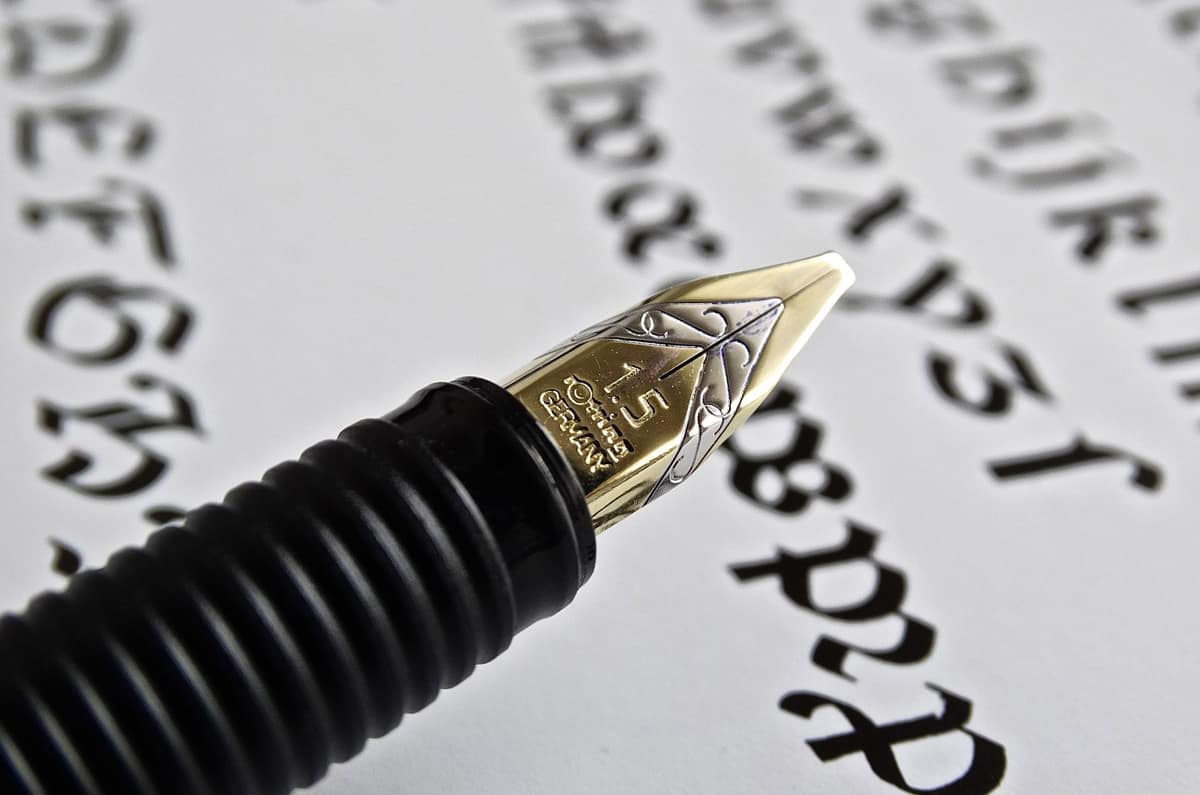
A nib grade is a letter — EF, F, M, B — and those letters mean different widths at different makers. A Japanese Fine is roughly a Western Extra Fine. That single fact is responsible for more disappointed first purchases than anything else in this hobby, and it is why the nib size guide is the first page we would send anyone to.
For a beginner the default is Fine, because a narrower nib puts less ink on the page and therefore feathers and bleeds less on whatever paper you already own. Go broader once you have paper that can take it. It is also why so many beginner recommendations end up Japanese — see the best Japanese fountain pens.
2. How the pen takes ink
Three answers exist. A cartridge is a sealed plastic tube you push in. A converter is a small refillable piston you fit in the cartridge's place and fill from a bottle. A piston filler builds the mechanism into the pen itself, so the barrel is the reservoir.
The trap is that cartridges are not universal. Pilot, LAMY and Platinum each use their own, and the international standard cartridge that fits everything else will not fit any of them. Check what fits your pen before you order refills, and read cartridge versus converter before you decide which way to go.
3. How the pen makes you hold it
Most pens leave your grip alone. A few do not: the LAMY Safari has a triangular grip section that permits exactly one hand position, and the Faber-Castell Grip uses molded dots to add friction without dictating position. Both are deliberate, and the first one is genuinely divisive. If your grip is unconventional, this is the specification that will decide whether you keep the pen.
4. What you will write on
A wet nib on thin paper produces a fuzzy line that shows through to the other side, and the pen gets blamed for it. Buy the paper at the same time as the pen — the notebook roundup is the companion to this page, and the bleed, ghosting and feathering guide explains which of those three you are actually looking at.
Where to start, by situation
| If this is you | Start with | Because |
|---|---|---|
| You just want one pen that works | Pilot Metropolitan | Brass body, a narrow Japanese Fine nib, and the most consistent recommendation in the category. |
| You want to fix your grip | LAMY Safari | The triangular section allows one hand position, and it is the correct one. |
| You want bottled ink from day one | TWSBI ECO | A piston filler at a cartridge-pen price, with the ink level visible through the barrel. |
| You want to spend as little as possible | Platinum Preppy | The maker publishes the nib width in millimeters and the cap resists drying out for months. |
| You are buying for a child | Pilot Kakuno | Hexagonal so it does not roll, with a face on the nib showing which way is up. |
| You want a big pen for very little | Jinhao X159 | A No. 8 nib and a converter in the box, with international standard cartridges. |
Quick picks
Ranked for the beginner buying their first setup. Every pick names who it is wrong for.
| # | Product | Best for | Price |
|---|---|---|---|
| 1 |  Pilot Metropolitan A brass-bodied pen with a nib far better than the price suggests, and the one most consistently handed to beginners. | The default first pen | $27.37 · View on Amazon #ad Price as of October 18, 2026. How this is funded |
| 2 |  LAMY Safari A molded triangular grip forces the pen into the right position, which is either the best or the worst thing about it. | Learning a correct grip | $30.95 · View on Amazon #ad Price as of October 18, 2026. How this is funded |
| 3 |  TWSBI ECO A piston filler with a clear barrel at the price other brands charge for a cartridge pen, so the ink is visible and the refill is free. | Using bottled ink from day one | $38.99 · View on Amazon #ad Price as of October 18, 2026. How this is funded |
1. The default first pen
Pilot Metropolitan
A brass-bodied pen with a nib far better than the price suggests, and the one most consistently handed to beginners.
#ad Price as of October 18, 2026. How this is funded
The brass body is the reason this pen feels like it costs more than it does. It gives the pen weight in the hand and a cold, solid grip section, which is the single thing most people notice moving up from a plastic school pen.
The nib is a Japanese Fine. That matters more than the letter suggests: Japanese grades run narrower than German ones, so a Pilot Fine lays a line closer to what a European maker would call extra fine. If you write small or on thin paper, that narrowness is doing you a favor.
The catch is filling. The Metropolitan takes Pilot's own cartridges, not the international standard ones every other brand shares, and the converter you need to use bottled ink is a separate purchase.
| Nib grades offered | Fine and Medium (stub also sold separately)Source: Pilot Metropolitan, Fine (retail listing, read 2026-09-01) |
|---|---|
| Nib width in mm | Not publishedPilot does not state a millimeter width for the Metropolitan nib in this listing. Japanese Fine runs narrower than a German Fine — see the nib size guide. |
| Body | Brass barrel, painted finishSource: Pilot Metropolitan, Fine (retail listing, read 2026-09-01) |
| Filling | Pilot proprietary cartridge, or a Pilot CON-40 / CON-70 converter (sold separately)Source: Pilot CON-40 converter (retail listing, read 2026-09-01) |
| In the box | Pen with one black ink cartridge and a squeeze converterSource: Pilot Metropolitan, Fine (retail listing, read 2026-09-01) |
What it does well
- Brass body at a plastic-pen price
- Japanese Fine nib puts down a narrow, controlled line
- Extremely widely stocked, so replacements and spares are easy
What it does not
- Proprietary Pilot cartridges, not the international standard
- Converter is sold separately
- The painted finish scuffs if you pocket-carry it with keys
Skip this if you want to use bottled ink on day one without a second purchase, or if you already know you prefer a broad, wet line.
2. Learning a correct grip
LAMY Safari
A molded triangular grip forces the pen into the right position, which is either the best or the worst thing about it.
#ad Price as of October 18, 2026. How this is funded
The grip section is the entire argument. It is molded into a triangle, so there is exactly one way to hold the pen, and it happens to be the way that keeps the nib flat against the paper. For someone who has spent twenty years white-knuckling a ballpoint, that is a genuine teaching aid.
It is also the reason some people hate it. If your natural grip is unusual, the Safari will fight you every time you pick it up, and no amount of practice makes a molded plastic triangle move.
Everything else about the pen is deliberately easy. The nib pulls off and pushes on by hand, so if you buy a Fine and want a Medium later, that is a five-dollar part rather than a new pen.
| Nib grades offered | Extra Fine, Fine, Medium, Broad, plus a dedicated left-hander nibSource: LAMY Safari, Fine (retail listing, read 2026-09-01) |
|---|---|
| Nib width in mm | Not published |
| Nib | Interchangeable steel nib unit — pulls off and swaps without toolsSource: LAMY Safari, Fine (retail listing, read 2026-09-01) |
| Filling | LAMY T10 proprietary cartridge, or the LAMY Z28 converterSource: LAMY Z28 converter (retail listing, read 2026-09-01) |
| Body | ABS plastic with a molded triangular grip sectionSource: LAMY Safari, Fine (retail listing, read 2026-09-01) |
What it does well
- Swappable nib units mean one pen can change its line width
- A dedicated left-handed nib grade exists, which is rare
- Nearly indestructible plastic body
What it does not
- The triangular grip is not optional and does not suit every hand
- LAMY cartridges are proprietary — the Z28 converter is a separate buy
- German Fine is wider than a Japanese Fine, which surprises people
Skip this if you hold a pen unconventionally, or if your handwriting is small enough that a German Fine will fill in your loops.
3. Using bottled ink from day one
TWSBI ECO
A piston filler with a clear barrel at the price other brands charge for a cartridge pen, so the ink is visible and the refill is free.
#ad Price as of October 18, 2026. How this is funded
A piston filler holds far more ink than a cartridge and costs nothing to refill after the first bottle. That combination usually starts at three times this price, which is why the ECO turns up on every beginner list that takes bottled ink seriously.
The clear barrel is not just decoration. You can see how much ink is left, which removes the most common beginner surprise: a pen that stops mid-sentence with no warning.
TWSBI's own guidance on choosing a nib is unusually plain: extra fine if you write small, fine for a normal hand, medium if you write large, broad for headings and signatures.
| Nib grades offered | Extra Fine, Fine, Medium, Broad, Stub 1.1Source: TWSBI, ECO product page (read 2026-09-01) |
|---|---|
| Nib width in mm | Not published |
| Filling | Built-in piston — unscrew the end cap, dip the nib, screw it backSource: TWSBI, ECO product page (read 2026-09-01) |
| Cap | Inner cap for a seal when stored; the cap posts on the barrelSource: TWSBI, ECO product page (read 2026-09-01) |
| Ink included | No — the pen ships emptySource: TWSBI, ECO product page (read 2026-09-01) |
What it does well
- Piston filler at a cartridge-pen price
- Clear barrel shows the ink level
- Five nib grades including a 1.1 mm stub
What it does not
- Requires a bottle of ink before it will write at all
- Clear plastic sections have a reputation for cracking if over-tightened
- No cartridge option, so it is not the pen to travel light with
Skip this if you want to write the day it arrives without also buying ink, or if you need cartridge convenience for a bag or a commute.
What we did not do
We have not written with any of these pens. There is no test bench here, no drawer of samples and no panel. What there is: the manufacturers' published specifications, the compatibility documentation, the points where established publishers such as The Pen Addict and Fountain Pen Love agree and disagree, and a price feed that runs daily. Every figure on every page here carries a source, and where a maker publishes nothing the page says 'not published' instead of guessing. The full method is on how we choose.
Everything in this section
- Best fountain pens for beginners — the main roundup, ranked
- Best fountain pens under $50 and under $100
- Best Japanese fountain pens — Pilot, Platinum and Sailor compared
- Fountain pen starter kits — pen, ink and paper bought together
- Best fountain pens for drawing and for long writing sessions
- Best flex nib fountain pens — line that goes thin to thick as you press
- Model reviews: Pilot Metropolitan, LAMY Safari, TWSBI ECO, Platinum Preppy, Pilot Kakuno, Jinhao X159, Kaweco Sport
- Head to head: Safari vs Metropolitan and ECO vs Safari, and Safari vs Kaweco Sport
Questions people actually ask
What is the best fountain pen for a complete beginner?
A Pilot Metropolitan with a Fine nib, for most people. It has a metal body, a narrow Japanese nib that copes with ordinary paper, and it is stocked everywhere. If you want to use bottled ink immediately, a TWSBI ECO is the better choice because it needs no converter.
How much should I spend on a first fountain pen?
Less than you think. The nib quality curve flattens quickly, and several pens in our under-fifty roundup write as well as pens costing five times more. Spend the difference on paper, which changes the result far more.
Do all fountain pens use the same ink cartridges?
No, and this is the most expensive assumption a beginner can make. Pilot, LAMY and Platinum each use a proprietary cartridge. Most other brands take the international standard, which comes in short and long versions. The compatibility guide lists which is which.
Why does my fountain pen bleed through the paper?
Usually because the paper is thin and uncoated rather than because the pen is faulty. A wet nib on 70 gsm paper will bleed; the same pen on 90 gsm coated paper will not. See bleed, ghosting and feathering for how to tell which problem you have.
Is a fountain pen worth it for everyday writing?
For long sessions, often yes, because a fountain pen needs almost no downward pressure — the ink flows by capillary action rather than by being rolled onto the page. The full argument, including where a ballpoint still wins, is on are fountain pens worth it.