Guides
Fountain pen nib sizes explained
A Japanese Fine and a German Fine are not the same width. Almost nobody publishes what either one actually measures.
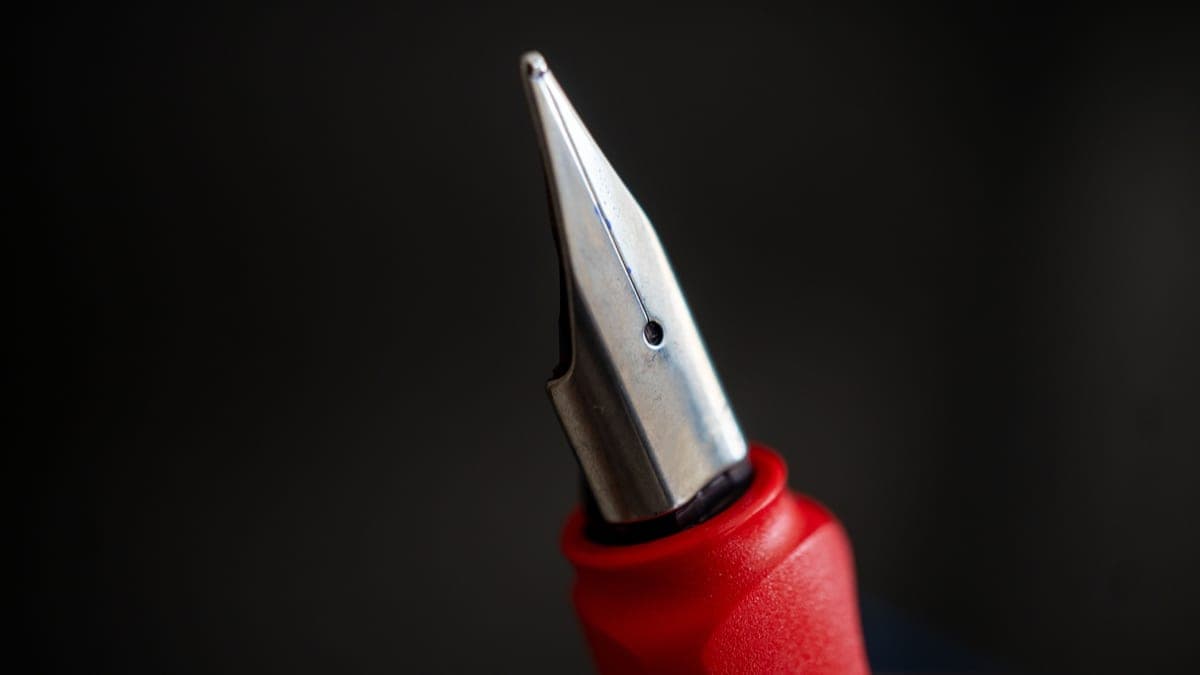
This is the single most useful thing to understand before buying a fountain pen, and it is the thing most likely to make a first purchase disappointing. The letters look like a standard. They are not one.
What the letters mean
| Grade | Name | Typically used for |
|---|---|---|
| EF | Extra Fine | Small handwriting, thin paper, annotation |
| F | Fine | General writing — the default for a first pen |
| M | Medium | Larger handwriting, good paper, signatures |
| B | Broad | Headings, signatures, deliberate emphasis |
| Stub | Stub or italic | Line variation — wide on downstrokes, narrow across |
Why Japanese and German grades differ
Japanese writing systems require a narrower line than the Latin alphabet does, because a kanji character packs far more strokes into the same space. Japanese makers therefore grade their whole range narrower, and the convention has stayed even for pens sold entirely into Western markets.
The practical consequence: a Pilot Fine lays down a line close to what LAMY would call an Extra Fine. If you buy a Japanese Medium expecting a European Medium you will get something noticeably narrower, and if you buy a German Fine expecting a Japanese Fine you will get something noticeably wetter and wider.
Who actually publishes a width
Almost nobody. This is the honest state of the category and it is worth stating plainly rather than papering over with a comparison chart of numbers nobody stands behind.
| Maker | Grades offered | Millimeter figure published? |
|---|---|---|
| Platinum (Preppy) | 02 and 03 | Yes — the grade IS the width: 02 is 0.2 mm, 03 is 0.3 mm |
| Pilot (Kakuno) | EF, F, M | Yes on the Fine — the listing states a 0.3 mm line size |
| Sailor (Lecoule) | F, M | Yes — the listing states a 0.3 mm line size |
| Pilot (Metropolitan) | F, M, plus a stub sold separately | No |
| LAMY (Safari) | EF, F, M, B, plus a left-hander grade | No |
| TWSBI (ECO) | EF, F, M, B, Stub 1.1 | Only for the stub, which is named 1.1 mm |
| Jinhao (X159) | EF, F, M | Contradictory — the listing says Fine and its own attribute field says 0.9 mm |
| Kaweco (Classic Sport) | EF through B | No |
That table is the reason this page exists. Four of the eight rows are a gap or a contradiction, and any site presenting a tidy cross-brand millimeter chart is filling those gaps with something other than published data. Note where the published figures cluster: all three are Japanese makers, which is one of the arguments on the best Japanese fountain pens.
How to choose without a number
- Start from your handwriting size. If your lowercase letters are under about 3 mm tall, go narrower than you think — a Medium will fill in the closed loops of a's, e's and o's.
- Then adjust for the maker's tradition. Japanese pen: F is the safe default, M if you write large. German pen: F is already wider, and EF is worth considering if you write small.
- Then adjust for your paper. Thin, absorbent paper wants the narrowest nib you can tolerate, because less ink is the whole fix.
- Then, if you want line variation, ignore all of the above and buy a stub. A stub is not a width, it is a shape: wide on the downstroke, narrow across, which produces calligraphic variation from ordinary handwriting - whether that is worth it is its own decision. A flex nib does the same job through pressure rather than shape.
Quick picks
Ranked for the beginner buying their first setup. Every pick names who it is wrong for.
| # | Product | Best for | Price |
|---|---|---|---|
| 1 |  Platinum Preppy The cheapest honest fountain pen on the shelf, and the only one on this page you can lose without minding. | Finding out whether you like fountain pens at all | $6.84 · View on Amazon #ad Price as of October 18, 2026. How this is funded |
| 2 |  Pilot Kakuno A hexagonal barrel that will not roll off a desk, a smiling face on the nib to show which way is up, and a genuinely good Pilot nib underneath. | Younger writers and small handwriting | $9.90 · View on Amazon #ad Price as of October 18, 2026. How this is funded |
| 3 |  LAMY Safari A molded triangular grip forces the pen into the right position, which is either the best or the worst thing about it. | Learning a correct grip | $30.95 · View on Amazon #ad Price as of October 18, 2026. How this is funded |
1. Finding out whether you like fountain pens at all
Platinum Preppy
The cheapest honest fountain pen on the shelf, and the only one on this page you can lose without minding.
#ad Price as of October 18, 2026. How this is funded
Platinum publishes the nib width in millimeters, which almost nobody else in this category does. That single fact makes the Preppy the cleanest reference point on the whole site: when we say a Japanese Fine is about 0.3 mm, this is the pen we can point at.
The slip-and-seal cap is the other reason it matters. Platinum's cap mechanism keeps the nib from drying out for months, so a Preppy left in a drawer usually writes on the first stroke — the failure that puts most beginners off fountain pens for good.
It is still a cheap plastic pen. The cap cracks if you post it hard, and the body is not built to survive a bag full of keys.
| Nib width in mm | Platinum names the nib by its width: 02 is 0.2 mm, 03 is 0.3 mmOne of the very few makers that states a millimeter figure at all.Source: Platinum Preppy 02, 0.2 mm (retail listing, read 2026-09-01) |
|---|---|
| Nib grades offered | 02 extra fine and 03 fine, in several barrel colorsSource: Platinum Preppy, Fine (retail listing, read 2026-09-01) |
| Filling | Platinum proprietary cartridge; a Platinum converter fits the same barrelSource: Platinum Carbon ink cartridges (retail listing, read 2026-09-01) |
| Body | Transparent plastic, snap capSource: Platinum Preppy, Fine (retail listing, read 2026-09-01) |
What it does well
- The maker actually publishes the nib width in millimeters
- Cap seal genuinely resists drying out between uses
- Cheap enough to be a test rather than a commitment
What it does not
- Plastic cap cracks under pressure
- Proprietary Platinum cartridges
- No weight to it — feels like the disposable it nearly is
Skip this if you want a pen that feels substantial in the hand, or if you plan to carry it loose in a bag every day.
2. Younger writers and small handwriting
Pilot Kakuno
A hexagonal barrel that will not roll off a desk, a smiling face on the nib to show which way is up, and a genuinely good Pilot nib underneath.
#ad Price as of October 18, 2026. How this is funded
The Kakuno was designed for Japanese schoolchildren, and every design decision follows from that: hexagonal so it stays put, a face embossed on the nib so you can see at a glance whether you are holding it upside down, and a nib tuned to be forgiving rather than fast.
It shares a nib family with the Metropolitan, so the writing experience is closer to that pen than the price gap suggests. What you give up is the brass body and the sense of occasion.
The cap does not post, which is a real annoyance for anyone with large hands — you either hold a slightly short pen or find somewhere to put the cap.
| Line width | 0.3 mm on the Fine nibStated in the listing's own product attributes.Source: Pilot Kakuno, Fine (retail listing, read 2026-09-01) |
|---|---|
| Nib grades offered | Extra Fine, Fine, MediumSource: Pilot Kakuno, Extra Fine 0.3 mm (retail listing, read 2026-09-01) |
| Body | Hexagonal plastic barrel; the cap does not postSource: Pilot Kakuno, Fine (retail listing, read 2026-09-01) |
| Filling | Pilot proprietary cartridge, or a Pilot CON-40 converterSource: Pilot CON-40 converter (retail listing, read 2026-09-01) |
What it does well
- The maker publishes a millimeter figure for the nib
- Hexagonal barrel does not roll
- Same Pilot nib quality as pens costing twice as much
What it does not
- The cap does not post on the barrel
- Unmistakably a children's pen to look at
- Proprietary Pilot cartridges
Skip this if the pen has to look serious on a desk at work, or if you have large hands and need to post the cap.
3. Learning a correct grip
LAMY Safari
A molded triangular grip forces the pen into the right position, which is either the best or the worst thing about it.
#ad Price as of October 18, 2026. How this is funded
The grip section is the entire argument. It is molded into a triangle, so there is exactly one way to hold the pen, and it happens to be the way that keeps the nib flat against the paper. For someone who has spent twenty years white-knuckling a ballpoint, that is a genuine teaching aid.
It is also the reason some people hate it. If your natural grip is unusual, the Safari will fight you every time you pick it up, and no amount of practice makes a molded plastic triangle move.
Everything else about the pen is deliberately easy. The nib pulls off and pushes on by hand, so if you buy a Fine and want a Medium later, that is a five-dollar part rather than a new pen.
| Nib grades offered | Extra Fine, Fine, Medium, Broad, plus a dedicated left-hander nibSource: LAMY Safari, Fine (retail listing, read 2026-09-01) |
|---|---|
| Nib width in mm | Not published |
| Nib | Interchangeable steel nib unit — pulls off and swaps without toolsSource: LAMY Safari, Fine (retail listing, read 2026-09-01) |
| Filling | LAMY T10 proprietary cartridge, or the LAMY Z28 converterSource: LAMY Z28 converter (retail listing, read 2026-09-01) |
| Body | ABS plastic with a molded triangular grip sectionSource: LAMY Safari, Fine (retail listing, read 2026-09-01) |
What it does well
- Swappable nib units mean one pen can change its line width
- A dedicated left-handed nib grade exists, which is rare
- Nearly indestructible plastic body
What it does not
- The triangular grip is not optional and does not suit every hand
- LAMY cartridges are proprietary — the Z28 converter is a separate buy
- German Fine is wider than a Japanese Fine, which surprises people
Skip this if you hold a pen unconventionally, or if your handwriting is small enough that a German Fine will fill in your loops.
Nibs you can change your mind about
LAMY's nib is a friction-fit unit that pulls off by hand, so a Safari or AL-star owner can change width for the price of a part rather than a pen. TWSBI sells nib units separately for the same reason. Everything else on this site means committing at purchase.
If you are genuinely unsure, that swappability is worth real money — it is the main reason the Safari ranks as highly as it does on our beginner roundup.
What a wider nib actually changes
- More ink on the page. Which means more feathering, more show-through, and longer drying — all worse on cheap paper.
- More visible ink character. Shading barely registers in an extra fine and is obvious in a broad.
- A smoother feel. Wider nibs generally feel smoother because more tipping material contacts the page.
- Fewer words per line. Which matters if you write in a pocket notebook or a bullet journal log.
- A longer wait before you can touch the page. More ink takes longer to dry, which is why nib width is the first lever on the left-handers page.
- A narrower line, if you go the other way. The extra fine roundup collects the pens that publish an actual width in millimeters rather than a letter.
- A shaped line, if you go wider still. Stub and parallel nibs vary the line by geometry rather than width - the calligraphy roundup sorts those by mechanism.
Questions people actually ask
What nib size should a beginner buy?
Fine, in almost every case. It puts less ink on the page than a Medium, which means less feathering and bleed-through on ordinary paper. Go to Extra Fine if you write small, or Medium if you write large on good paper.
Is a Japanese Fine the same as a German Fine?
No. Japanese grades run roughly one step narrower, so a Japanese Fine is close to a Western Extra Fine. This is the most common cause of a disappointing first purchase.
What is the actual width of a fountain pen nib in millimeters?
For most pens, nobody publishes it. Platinum names the Preppy's nibs by width — 02 is 0.2 mm, 03 is 0.3 mm — and Pilot states 0.3 mm for the Kakuno Fine. LAMY, Kaweco and most others publish nothing.
What is a stub nib?
A shape rather than a width: wide on the downstroke and narrow across, so ordinary handwriting comes out with calligraphic line variation. TWSBI's is named 1.1 mm after that wide dimension. Whether a stub is worth buying, and which pens offer one, is covered on its own page: /guides/is-a-stub-nib-worth-it
Can I change the nib on my fountain pen?
On some. LAMY's nibs are friction-fit units that pull off by hand, and TWSBI sells nib units separately. Most other pens in this price range commit you at purchase.
Sources
- Platinum Preppy 02, 0.2 mm (retail listing, read 2026-09-01)
- Platinum Preppy, Fine (retail listing, read 2026-09-01)
- Pilot Kakuno, Fine — 0.3 mm line size (retail listing, read 2026-09-01)
- LAMY Safari, Fine (retail listing, read 2026-09-01)
- Jinhao X159, Fine (retail listing, read 2026-09-01)
- TWSBI, ECO product page (read 2026-09-01)