Ink
Pilot Iroshizuku: what the premium buys
The range most people move to after their first bottle, at several times the price. Here is what changes, and when it does not.
How this page is funded. Buying through a link here earns us a commission at no extra cost to you. It does not change what we recommend or the order we recommend it in, and we have not hands-on tested these products — see how we choose and the full disclosure.
Iroshizuku is the range almost everyone arrives at second. It costs several times what an everyday bottle costs, the bottles are beautiful in a way that has nothing to do with writing, and the colors have Japanese names that mean things like 'deep azure' and 'bamboo charcoal'.
The question worth answering is what actually changes on the page.
What shading is
As a nib moves, it deposits ink unevenly — more where it slows or changes direction, less on a fast straight stroke. If the ink dries at a consistent density, that variation is invisible. If it dries darker where it pooled, the stroke shows a gradient from pale to deep.
That gradient is shading, and it is what makes handwriting in a shading ink look considered rather than printed. Iroshizuku shades noticeably, and Kon-peki is one of the clearest examples in the range.
Quick picks
Ranked for the beginner buying their first setup. Every pick names who it is wrong for.
| # | Product | Best for | Price |
|---|---|---|---|
| 1 |  Pilot Iroshizuku Kon-peki, 50 ml A deep azure blue that flows generously and shades from pale to dark within a single stroke on good paper. | The first bottle worth being excited about | $18.80 · View on Amazon #ad Price as of October 18, 2026. How this is funded |
| 2 | 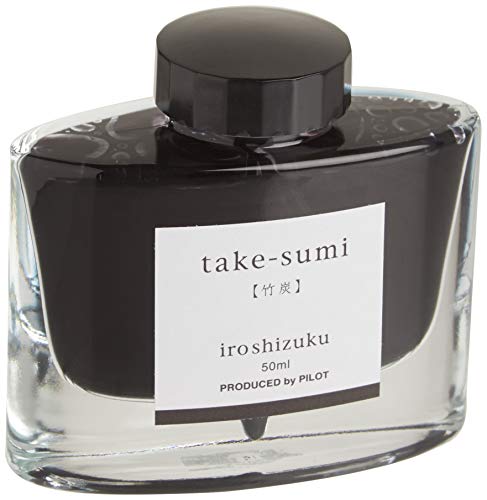 Pilot Iroshizuku Take-sumi, 50 ml A bamboo-charcoal black with enough warmth that a page of it does not read as printer output. | A black that is not flat | $23.90 · View on Amazon #ad Price as of October 18, 2026. How this is funded |
1. The first bottle worth being excited about
Pilot Iroshizuku Kon-peki, 50 ml
A deep azure blue that flows generously and shades from pale to dark within a single stroke on good paper.
#ad Price as of October 18, 2026. How this is funded
Iroshizuku is where most people discover that ink can be interesting. Kon-peki shades — the same stroke goes light where the ink pooled less and dark where it pooled more — and that variation is what makes handwriting look considered rather than printed.
It is a wet ink. On the 70 gsm paper in a supermarket notebook it will show through, and on the worst paper it will bleed. Pair it with 90 gsm or better and it behaves.
It costs several times what a bottle of everyday blue costs, and it will last you a year of daily writing regardless.
| Format | 50 ml bottleSource: Pilot Iroshizuku Kon-peki (retail listing, read 2026-09-01) |
|---|---|
| Color | Kon-peki, deep azure blueSource: Pilot Iroshizuku Kon-peki (retail listing, read 2026-09-01) |
| Behavior noted in the listing | Shading and sheen, most visible with broader nibsSource: Pilot Iroshizuku Kon-peki (retail listing, read 2026-09-01) |
| Published drying time | Not published |
What it does well
- Genuine shading that rewards good paper
- Flows generously in dry-writing nibs
- One bottle lasts a very long time
What it does not
- Wet flow means bleed-through on thin paper
- Several times the price of an everyday blue
- Not water resistant
Skip this if the paper you actually write on is thin office stock — a wet ink on absorbent paper wastes the ink and ruins the page.
2. A black that is not flat
Pilot Iroshizuku Take-sumi, 50 ml
A bamboo-charcoal black with enough warmth that a page of it does not read as printer output.
#ad Price as of October 18, 2026. How this is funded
Most fountain pen blacks are either weak or aggressively saturated. Take-sumi sits between: dark enough to look deliberate, soft enough that a full page is comfortable to read.
Like the rest of the Iroshizuku range it runs on the wet side, so the paper conversation applies.
If you want a black that survives water, this is not it — that is a job for a pigment ink.
| Format | 50 ml bottleSource: Pilot Iroshizuku Take-Sumi (retail listing, read 2026-09-01) |
|---|---|
| Color | Take-sumi, bamboo charcoal blackSource: Pilot Iroshizuku Take-Sumi (retail listing, read 2026-09-01) |
| Published drying time | Not published |
| Published water resistance | Not published |
What it does well
- A black with visible character rather than flat opacity
- Flows well in dry nibs
- Same well-behaved dye base as the rest of the range
What it does not
- Wet flow on thin paper
- Premium price
- No water resistance
Skip this if you need archival or waterproof writing — use a pigment ink and clean the pen more often.
It runs wet
Generous flow is part of how the range achieves its look, and it has consequences. In a dry-writing nib it is a genuine improvement. On thin paper it will show through and may bleed. If your notebook is a Moleskine or a school exercise book, this is the wrong ink.
Which to start with
| Color | What it is | Buy it if |
|---|---|---|
| Kon-peki | Deep azure blue | You want the clearest demonstration of what shading looks like. |
| Take-sumi | Bamboo charcoal black | You want a black with warmth rather than flat opacity. |
| Shin-kai | Deep sea blue-black | You want something that reads as serious on a printed page. |
All three are standard dye inks with no shimmer or pigment, so they flush out of a pen normally.
When it is not worth it
If you write on paper you do not control, if you write in a pen with a very fine nib where shading barely registers, or if you go through ink fast enough that price per milliliter matters — then a Diamine bottle at a fraction of the cost is the better purchase, and you are not missing much.
The honest framing is that Iroshizuku is a pleasure purchase that happens to also be a good ink. That is a perfectly reasonable thing to buy; it is just not a performance upgrade.
Questions people actually ask
Is Pilot Iroshizuku ink worth the price?
If you write on good paper with a medium or broader nib, yes — the shading is genuinely visible and the flow suits dry nibs. On cheap paper or in a very fine nib, most of what you are paying for does not show, and a Diamine bottle is better value.
What is shading in fountain pen ink?
Variation in tone within a single stroke, caused by ink pooling unevenly as the nib moves and drying darker where it pooled. It only appears on paper that keeps ink at the surface.
Which Iroshizuku color should I buy first?
Kon-peki, a deep azure blue, is the clearest demonstration of the range's shading. Take-sumi is the choice if you want a black with more character than a flat one.
Does Iroshizuku bleed through paper?
It runs on the wet side, so on thin uncoated paper it will show through and may bleed. On 90 gsm coated paper it behaves — see inks that do not bleed if your paper is fixed.