Paper
Paper for fountain pens
The half of the setup nobody sells you, and the half that decides whether the other half looks any good.
How this page is funded. Buying through a link here earns us a commission at no extra cost to you. It does not change what we recommend or the order we recommend it in, and we have not hands-on tested these products — see how we choose and the full disclosure.
Almost every complaint a new fountain pen owner has is a paper complaint wearing a pen costume. The line is fuzzy. The writing shows through. The ink took forever to dry. All three are decided by the sheet, not the nib — and all three disappear when the sheet changes.
There is a structural reason this is under-covered elsewhere. Nearly every paper roundup published in this category is written by a retailer or a notebook brand, which makes 'buy better paper' an awkward thing to say plainly. We sell nothing at all, so we can.
Three properties, and weight is the least important
Sizing — the one that actually matters
Sizing is a treatment applied during manufacture that makes paper resist liquid. Heavily sized paper holds ink at the surface, so the line stays sharp and the ink dries slowly. Lightly sized paper lets ink into the fiber structure, where it spreads sideways and, given enough of it, straight through.
This is why a 52 g/m2 sheet of Tomoe River resists bleeding better than a 70 gsm Moleskine page. Weight is not the variable people think it is.
Coating
A coated sheet has a thin sealed layer on top of the fibers. It behaves like heavy sizing taken further: extremely sharp lines, extremely slow drying. Clairefontaine and Rhodia are the reference examples, which is exactly why they are also the worst choice for a left-handed writer who smudges.
Weight, in grams per square meter
GSM is a useful rough guide within a single manufacturing tradition and a poor one across traditions. Japanese 80 gsm is denser and better sized than European 80 gsm office stock and outperforms it comfortably. The GSM guide sets out what each band actually predicts.
Quick picks
Ranked for the beginner buying their first setup. Every pick names who it is wrong for.
| # | Product | Best for | Price |
|---|---|---|---|
| 1 | 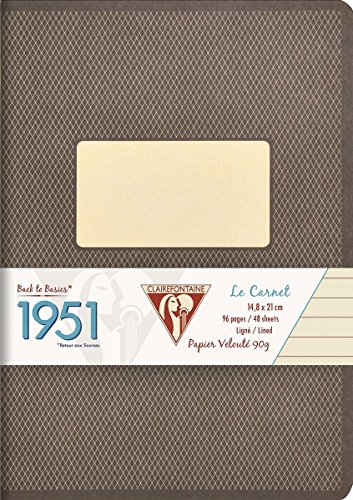 Clairefontaine 1951 A5, lined 90 g/m2 vellum in a stapled softcover, which is the cheapest place to find paper this good. | The best paper per dollar | $9.99 · View on Amazon #ad Price as of October 18, 2026. How this is funded |
| 2 |  Rhodia Webnotebook A5, dot Clairefontaine paper in a hardcover book, which is the shortest route to a journal that a wet nib cannot ruin. | A hardcover journal that holds wet ink | $30.76 · View on Amazon #ad Price as of October 18, 2026. How this is funded |
| 3 |  Black n' Red A5 casebound (3-pack) 90 gsm Optik paper in a hardback casebound cover, sold in threes, and stocked by every office supplier. | An office notebook you can actually buy anywhere | $38.04 · View on Amazon #ad Price as of October 18, 2026. How this is funded |
1. The best paper per dollar
Clairefontaine 1951 A5, lined
90 g/m2 vellum in a stapled softcover, which is the cheapest place to find paper this good.
#ad Price as of October 18, 2026. How this is funded
This is the paper that makes the case on its own. 90 g/m2 coated vellum is the benchmark the rest of the market is measured against, and here it comes in a stapled book that costs less than a takeout lunch.
The softcover is the compromise. It will not survive being thrown in a bag for a year the way a hardcover will.
If you want to know whether your bleed-through problem is the ink or the paper, buy one of these and write the same page again. The answer is usually immediate.
| Paper weight | 90 g/m2 white velvet vellumSource: Clairefontaine 1951 A5 (retail listing, read 2026-09-01) |
|---|---|
| Maker's claim | Remarkable opacity and strengthThe maker's own wording on its listing.Source: Clairefontaine 1951 A5 (retail listing, read 2026-09-01) |
| Size and extent | 5 3/4" x 8 1/4", 96 pages, linedSource: Clairefontaine 1951 A5 (retail listing, read 2026-09-01) |
| Binding | Staplebound softcoverSource: Clairefontaine 1951 A5 (retail listing, read 2026-09-01) |
What it does well
- Published 90 g/m2 weight at a very low price
- The reference paper for fountain pen use
- Cheap enough to keep several
What it does not
- Softcover, so it wears in a bag
- 96 pages goes quickly
- Slow drying, like all coated paper
Skip this if you need a book that survives daily carry — buy the clothbound version instead.
2. A hardcover journal that holds wet ink
Rhodia Webnotebook A5, dot
Clairefontaine paper in a hardcover book, which is the shortest route to a journal that a wet nib cannot ruin.
#ad Price as of October 18, 2026. How this is funded
Rhodia and Clairefontaine are the same group, and the paper is the reason to buy either. It is coated and hard-sized, so ink sits on the surface rather than soaking in — which is what stops feathering before it starts.
A wet ink in a broad nib is the hardest test a notebook faces. This is the book that passes it.
The trade is drying time. Ink that sits on the surface takes noticeably longer to dry, which matters if you are left-handed or in a hurry.
| Size | A5Source: Rhodia Webnotebook A5, dot (retail listing, read 2026-09-01) |
|---|---|
| Ruling | Dot gridSource: Rhodia Webnotebook A5, dot (retail listing, read 2026-09-01) |
| Paper weight | 90 g Ivory Brushed VellumPublished on the listing as of the 2026-10-17 read. It was absent at the 2026-09-01 read, so this row is newer than the rest of the entry.Source: Rhodia A5 Webnotebook, Dot (47391EX) (retail listing, read 2026-10-17) |
| Extent | 96 sheetsSource: Rhodia A5 Webnotebook, Dot (47391EX) (retail listing, read 2026-10-17) |
| Closure and extras | Leatherette cover with an elasticated strap, a ribbon marker and an expanding back pocketSource: Rhodia A5 Webnotebook, Dot (47391EX) (retail listing, read 2026-10-17) |
| Cover | HardcoverSource: Rhodia Webnotebook A5, dot (retail listing, read 2026-09-01) |
What it does well
- Coated paper that resists feathering and bleed-through
- Hardcover, so it survives a bag
- Dot grid is the most flexible ruling
What it does not
- Slow drying, which punishes left-handers
- Expensive per page next to a plain notebook
- Its listing is not in a shipping state at the time of writing
Skip this if you write left-handed and smudge — coated paper is the worst case for drying time.
3. An office notebook you can actually buy anywhere
Black n' Red A5 casebound (3-pack)
90 gsm Optik paper in a hardback casebound cover, sold in threes, and stocked by every office supplier.
#ad Price as of October 18, 2026. How this is funded
This is the surprise on the list. An ordinary office notebook, sold in multipacks, with a published 90 gsm paper and a hardback cover — the same weight as the specialist books at a fraction of the price per page.
It is not coated paper, so it dries faster than a Clairefontaine and looks slightly less crisp. For most people, faster drying is the better trade.
The three-pack is the honest way to buy it: at this price a single book is barely worth the shipping.
| Paper weight | 90 gsm Optik paperSource: Oxford Black n' Red A5 (retail listing, read 2026-09-01) |
|---|---|
| Maker's claim | Minimal show-through of notesThe maker's own wording on its listing.Source: Oxford Black n' Red A5 (retail listing, read 2026-09-01) |
| Extent | A5, 192 pages, linedSource: Oxford Black n' Red A5 (retail listing, read 2026-09-01) |
| Binding | Hardback caseboundSource: Oxford Black n' Red A5 (retail listing, read 2026-09-01) |
What it does well
- Published 90 gsm at an office-supply price
- Hardback casebound and genuinely durable
- Dries faster than coated paper
What it does not
- Sold in a three-pack, so it is not a small purchase
- Lined only
- Corporate red-and-black looks exactly like what it is
Skip this if you want one notebook rather than three, or if you need a dot grid.
What each maker publishes, and what it does not
| Notebook | Weight the maker publishes |
|---|---|
| Clairefontaine 1951 | 90 g/m2 white velvet vellum |
| Rhodia Goalbook | 90 gsm |
| Black n' Red A5 | 90 gsm Optik paper |
| Maruman Mnemosyne | 80 g/m2, acid-free |
| Dingbats Wildlife | 100 gsm, acid-free |
| Tomoe River FP | 52 g/m2 |
| Moleskine Classic | 70 gsm |
| LEUCHTTURM1917 A5 | 80 g/m2, acid-free |
| Midori MD | Not published |
| Apica Premium CD | Not published |
Those last two rows are the reason this table exists. Two well-regarded notebooks publish no weight at all, and we are not going to fill the gap with a number from a review or a competitor's comparison chart. A missing figure is a finding, and it belongs in the table as one.
Everything in this section
- Best notebooks for fountain pens — the main roundup
- Best notebooks for journaling and cheap notebooks that do not bleed
- Best B5 notebooks and best dot grid notebooks
- Paper profiles: Tomoe River, Rhodia, Clairefontaine, LEUCHTTURM1917, Midori MD
- Head to head: Rhodia vs Clairefontaine LEUCHTTURM1917 vs Moleskine and Rhodia vs LEUCHTTURM1917
Questions people actually ask
What paper is best for fountain pens?
Coated or heavily sized paper at 90 gsm or above. Clairefontaine and Rhodia are the reference examples. If you are left-handed and smudge, uncoated 90 gsm dries faster and is the better choice.
Does higher GSM always mean less bleed-through?
No. Sizing matters more than weight. A 52 g/m2 Tomoe River sheet resists bleeding better than a 70 gsm Moleskine page, because the Tomoe River is hard-sized and keeps ink at the surface.
What GSM paper should I use with a fountain pen?
90 gsm and above handles almost any pen and ink. 80 gsm is workable with a fine nib and a dry ink, especially Japanese paper. Below 80 gsm, expect show-through unless the paper is unusually well sized.
Why does my fountain pen ink show through the page?
If you can see the writing but no ink has come through, that is ghosting, and it is normal on thin paper. If ink has actually penetrated, that is bleeding. The difference and the fixes are here.
Is Moleskine paper good for fountain pens?
The Classic range is 70 gsm, which Moleskine publishes, and that is below what a wet nib needs. Their heavier papers are a different matter — see LEUCHTTURM1917 vs Moleskine.
Sources
- Clairefontaine 1951 A5 (retail listing, read 2026-09-01)
- Rhodia Goalbook A5 (retail listing, read 2026-09-01)
- Oxford Black n' Red A5 (retail listing, read 2026-09-01)
- Tomoe River FP Notebook A5 (retail listing, read 2026-09-01)
- Moleskine Classic, large ruled (retail listing, read 2026-09-01)
- The Goulet Pen Company