Fountain Pens
The best Japanese fountain pens for beginners
Three houses, narrower nibs than anything European, and the only makers in this category who will tell you a line width in millimeters.
How this page is funded. Buying through a link here earns us a commission at no extra cost to you. It does not change what we recommend or the order we recommend it in, and we have not hands-on tested these products — see how we choose and the full disclosure.
Ask which fountain pens beginners should buy and the answers skew Japanese, over and over, from people who have no particular reason to favor Japan. That is not national loyalty. It is a set of specific manufacturing decisions that happen to suit somebody who is about to write on whatever paper is already on their desk.
This page is about those decisions, what they cost you, and which of the three Japanese houses to start with.
What we mean by Japanese, and why it is a real category
Three companies dominate: Pilot, Platinum and Sailor. All three have been making pens for roughly a century, all three make their own nibs, and all three grade those nibs to a narrower scale than any European maker.
That last point is the whole category in one sentence. A Japanese Fine lays down a line close to what a German maker would call an Extra Fine. Japanese writing needs a narrower stroke than the Latin alphabet does, because a kanji character packs far more strokes into the same square, and the convention has stayed even on pens sold entirely into Western markets. The nib size guide works through the comparison properly.
The criteria we ranked on
Four things, applied in this order, and price is deliberately last.
- Does the maker publish a line width? Almost nobody in this category will give you a number in millimeters. Three of the pens below have one, and that makes them checkable rather than a matter of trust.
- How narrow is the nib, really? Not the letter on the box — the actual behavior on ordinary paper. Every pen here runs narrower than the European equivalent of the same grade.
- What does it commit you to? All three houses use their own cartridge. That is the category's shared weakness, and it costs more on some pens than others.
- Then price. The gap between the cheapest and dearest pen on this page is smaller than the gap between a good notebook and a bad one, which is why it sorts last.
Quick picks
Ranked for the beginner buying their first setup. Every pick names who it is wrong for.
| # | Product | Best for | Price |
|---|---|---|---|
| 1 |  Pilot Metropolitan A brass-bodied pen with a nib far better than the price suggests, and the one most consistently handed to beginners. | The default first pen | |
| 2 |  Platinum Preppy The cheapest honest fountain pen on the shelf, and the only one on this page you can lose without minding. | Finding out whether you like fountain pens at all | $6.84 · View on Amazon #ad Price as of October 18, 2026. How this is funded |
| 3 |  Pilot Kakuno A hexagonal barrel that will not roll off a desk, a smiling face on the nib to show which way is up, and a genuinely good Pilot nib underneath. | Younger writers and small handwriting | $9.90 · View on Amazon #ad Price as of October 18, 2026. How this is funded |
| 4 |  Sailor Lecoule Sailor's entry pen, and one of the very few at any price whose listing states the line width in millimeters. | The third of the big three Japanese makers | $23.82 · View on Amazon #ad Price as of October 18, 2026. How this is funded |
| 5 |  Platinum Plaisir The Preppy's nib and its excellent cap seal, wrapped in anodized aluminum instead of cracking plastic. | A Preppy nib in a body that survives a bag | $24.24 · View on Amazon #ad Price as of October 18, 2026. How this is funded |
| 6 |  Pilot Prera A compact Pilot with the converter already in the box, which removes the Metropolitan's one real annoyance. | Small hands and a short pen | $35.00 · View on Amazon #ad Price as of October 18, 2026. How this is funded |
| 7 | 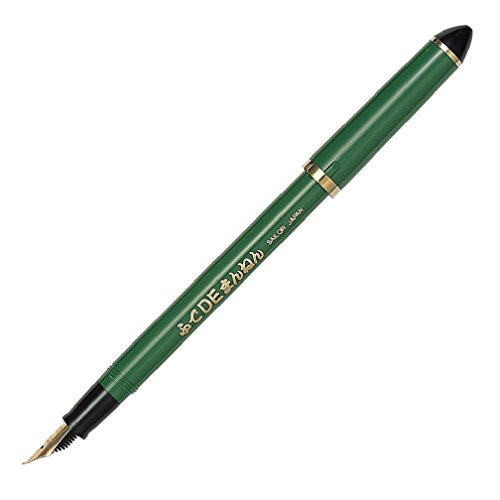 Sailor Fude De Mannen A nib bent upward at a stated angle, so tilting the pen changes the stroke from hairline to broad. Nothing else this cheap does it. | Line variation without learning calligraphy | $12.70 · View on Amazon #ad Price as of October 18, 2026. How this is funded |
1. The default first pen
Pilot Metropolitan
A brass-bodied pen with a nib far better than the price suggests, and the one most consistently handed to beginners.
The brass body is the reason this pen feels like it costs more than it does. It gives the pen weight in the hand and a cold, solid grip section, which is the single thing most people notice moving up from a plastic school pen.
The nib is a Japanese Fine. That matters more than the letter suggests: Japanese grades run narrower than German ones, so a Pilot Fine lays a line closer to what a European maker would call extra fine. If you write small or on thin paper, that narrowness is doing you a favor.
The catch is filling. The Metropolitan takes Pilot's own cartridges, not the international standard ones every other brand shares, and the converter you need to use bottled ink is a separate purchase.
| Nib grades offered | Fine and Medium (stub also sold separately)Source: Pilot Metropolitan, Fine (retail listing, read 2026-09-01) |
|---|---|
| Nib width in mm | Not publishedPilot does not state a millimeter width for the Metropolitan nib in this listing. Japanese Fine runs narrower than a German Fine — see the nib size guide. |
| Body | Brass barrel, painted finishSource: Pilot Metropolitan, Fine (retail listing, read 2026-09-01) |
| Filling | Pilot proprietary cartridge, or a Pilot CON-40 / CON-70 converter (sold separately)Source: Pilot CON-40 converter (retail listing, read 2026-09-01) |
| In the box | Pen with one black ink cartridge and a squeeze converterSource: Pilot Metropolitan, Fine (retail listing, read 2026-09-01) |
What it does well
- Brass body at a plastic-pen price
- Japanese Fine nib puts down a narrow, controlled line
- Extremely widely stocked, so replacements and spares are easy
What it does not
- Proprietary Pilot cartridges, not the international standard
- Converter is sold separately
- The painted finish scuffs if you pocket-carry it with keys
Skip this if you want to use bottled ink on day one without a second purchase, or if you already know you prefer a broad, wet line.
2. Finding out whether you like fountain pens at all
Platinum Preppy
The cheapest honest fountain pen on the shelf, and the only one on this page you can lose without minding.
#ad Price as of October 18, 2026. How this is funded
Platinum publishes the nib width in millimeters, which almost nobody else in this category does. That single fact makes the Preppy the cleanest reference point on the whole site: when we say a Japanese Fine is about 0.3 mm, this is the pen we can point at.
The slip-and-seal cap is the other reason it matters. Platinum's cap mechanism keeps the nib from drying out for months, so a Preppy left in a drawer usually writes on the first stroke — the failure that puts most beginners off fountain pens for good.
It is still a cheap plastic pen. The cap cracks if you post it hard, and the body is not built to survive a bag full of keys.
| Nib width in mm | Platinum names the nib by its width: 02 is 0.2 mm, 03 is 0.3 mmOne of the very few makers that states a millimeter figure at all.Source: Platinum Preppy 02, 0.2 mm (retail listing, read 2026-09-01) |
|---|---|
| Nib grades offered | 02 extra fine and 03 fine, in several barrel colorsSource: Platinum Preppy, Fine (retail listing, read 2026-09-01) |
| Filling | Platinum proprietary cartridge; a Platinum converter fits the same barrelSource: Platinum Carbon ink cartridges (retail listing, read 2026-09-01) |
| Body | Transparent plastic, snap capSource: Platinum Preppy, Fine (retail listing, read 2026-09-01) |
What it does well
- The maker actually publishes the nib width in millimeters
- Cap seal genuinely resists drying out between uses
- Cheap enough to be a test rather than a commitment
What it does not
- Plastic cap cracks under pressure
- Proprietary Platinum cartridges
- No weight to it — feels like the disposable it nearly is
Skip this if you want a pen that feels substantial in the hand, or if you plan to carry it loose in a bag every day.
3. Younger writers and small handwriting
Pilot Kakuno
A hexagonal barrel that will not roll off a desk, a smiling face on the nib to show which way is up, and a genuinely good Pilot nib underneath.
#ad Price as of October 18, 2026. How this is funded
The Kakuno was designed for Japanese schoolchildren, and every design decision follows from that: hexagonal so it stays put, a face embossed on the nib so you can see at a glance whether you are holding it upside down, and a nib tuned to be forgiving rather than fast.
It shares a nib family with the Metropolitan, so the writing experience is closer to that pen than the price gap suggests. What you give up is the brass body and the sense of occasion.
The cap does not post, which is a real annoyance for anyone with large hands — you either hold a slightly short pen or find somewhere to put the cap.
| Line width | 0.3 mm on the Fine nibStated in the listing's own product attributes.Source: Pilot Kakuno, Fine (retail listing, read 2026-09-01) |
|---|---|
| Nib grades offered | Extra Fine, Fine, MediumSource: Pilot Kakuno, Extra Fine 0.3 mm (retail listing, read 2026-09-01) |
| Body | Hexagonal plastic barrel; the cap does not postSource: Pilot Kakuno, Fine (retail listing, read 2026-09-01) |
| Filling | Pilot proprietary cartridge, or a Pilot CON-40 converterSource: Pilot CON-40 converter (retail listing, read 2026-09-01) |
What it does well
- The maker publishes a millimeter figure for the nib
- Hexagonal barrel does not roll
- Same Pilot nib quality as pens costing twice as much
What it does not
- The cap does not post on the barrel
- Unmistakably a children's pen to look at
- Proprietary Pilot cartridges
Skip this if the pen has to look serious on a desk at work, or if you have large hands and need to post the cap.
4. The third of the big three Japanese makers
Sailor Lecoule
Sailor's entry pen, and one of the very few at any price whose listing states the line width in millimeters.
#ad Price as of October 18, 2026. How this is funded
Pilot, Platinum and Sailor are the three Japanese houses that matter, and Sailor is the one most beginners never meet, because its reputation sits at the expensive end and its cheap pens are thin on the ground outside Japan. The Lecoule is the exception: a genuine entry-level Sailor with a real Sailor steel nib.
It matters to this site for a specific reason. Sailor's listing states a 0.3 mm line width, which is the same figure Pilot publishes for the Kakuno Fine and sits between Platinum's 02 and 03. Three Japanese makers publishing a number is what makes the Japanese half of the nib-width picture checkable at all.
What you are not getting is the ink system. Sailor uses its own cartridge, so a Lecoule joins the Pilot and Platinum lock-in rather than escaping it, and the converter is a separate purchase.
| Line width | 0.3 mmStated in the listing's own product attributes, which puts Sailor alongside Platinum and Pilot as a maker that will give you a number.Source: Sailor Lecoule, Fine (retail listing, read 2026-09-01) |
|---|---|
| Nib grades offered | Fine and MediumSource: Sailor Lecoule, Fine (retail listing, read 2026-09-01) |
| Filling | Sailor cartridge; Sailor sells its own converter separatelySource: Sailor fountain pen converter (retail listing, read 2026-09-01) |
| Body | Resin barrel, Power Stone color rangeSource: Sailor Lecoule, Fine (retail listing, read 2026-09-01) |
What it does well
- The maker states a line width in millimeters
- A real Sailor nib at the bottom of the range
- Fine and Medium both offered
What it does not
- Sailor's own cartridge, and a converter sold separately
- Harder to find in the US than Pilot or Platinum
- The Power Stone color range is a strong look
Skip this if you want the widest choice of nib grades or the easiest resupply — Pilot is stocked far more broadly in the US.
5. A Preppy nib in a body that survives a bag
Platinum Plaisir
The Preppy's nib and its excellent cap seal, wrapped in anodized aluminum instead of cracking plastic.
#ad Price as of October 18, 2026. How this is funded
The Plaisir is the answer to the one real complaint about the Preppy: the body. Same nib, same slip-and-seal cap that resists drying, but in metal.
That cap seal is the reason to care. A pen that writes on the first stroke after three weeks in a drawer is a pen that gets used, and Platinum's cap does that better than anything else at this price.
You are paying several times the Preppy's price for a body, not for a better nib. Whether that is worth it depends entirely on whether you carry the pen.
| Nib | Fine; the same nib unit family as the Platinum PreppySource: Platinum Plaisir, Fine (retail listing, read 2026-09-01) |
|---|---|
| Body | Anodized aluminumSource: Platinum Plaisir, Fine (retail listing, read 2026-09-01) |
| Filling | Platinum proprietary cartridge; a Platinum converter fitsSource: Platinum fountain pen converter (retail listing, read 2026-09-01) |
| Nib width in mm | 0.3 mm (Fine)Source: Platinum Plaisir, Fine nib (retail listing, read 2026-09-27) |
| Nib material | Stainless steelSource: Platinum Plaisir, Fine nib (retail listing, read 2026-09-27) |
| Cap | Slip and Seal mechanism, which Platinum states prevents ink drying outSource: Platinum Plaisir, Fine nib (retail listing, read 2026-09-27) |
What it does well
- Cap seal genuinely resists drying between uses
- Metal body at a modest price
- Nib shared with a pen whose width Platinum actually publishes
What it does not
- Costs several times the Preppy for the same writing experience
- Proprietary Platinum cartridges
- Colors are limited and loud
Skip this if the pen will live on a desk — a Preppy writes identically for a fraction of the money.
6. Small hands and a short pen
Pilot Prera
A compact Pilot with the converter already in the box, which removes the Metropolitan's one real annoyance.
#ad Price as of October 18, 2026. How this is funded
The Prera is short, which is the whole reason to choose it. Posted it is a normal length; unposted it suits a small hand better than anything else Pilot makes at this price.
The included converter matters more than it sounds. It is the difference between a pen that can use bottled ink today and one that needs a second order first.
The nib is the same Japanese Fine family as the Metropolitan and the Kakuno, so the line width will be familiar if you have used either.
| Nib | Steel, FineSource: Pilot Prera, Fine (retail listing, read 2026-09-01) |
|---|---|
| Filling | Pilot cartridge, with a CON-40 converter includedSource: Pilot Prera, Fine (retail listing, read 2026-09-01) |
| Body | Compact resin barrelSource: Pilot Prera, Fine (retail listing, read 2026-09-01) |
| Nib width in mm | Not published |
What it does well
- Converter included — bottled ink works immediately
- Genuinely compact
- Pilot nib quality
What it does not
- Costs more than the Metropolitan for a smaller pen
- Proprietary Pilot cartridges
- Limited nib range in US listings
Skip this if you have large hands, or if you would rather put the money into the pen's body than into a converter you could add later.
7. Line variation without learning calligraphy
Sailor Fude De Mannen
A nib bent upward at a stated angle, so tilting the pen changes the stroke from hairline to broad. Nothing else this cheap does it.
#ad Price as of October 18, 2026. How this is funded
A fude nib is bent upward near the tip, which means the width of your line depends on how steeply you hold the pen. Held almost flat it lays a broad stroke; tipped up onto the very end of the bend it writes a hairline. One pen, an enormous range.
Sailor publishes the bend angle rather than a width, which is the honest way to describe a nib whose width is a function of how you hold it. The 55-degree version has the more dramatic range; the 40-degree is closer to an ordinary pen with extra headroom.
It is not a first pen, and we are not ranking it as one. It is the pen to buy second, when the question has changed from whether you like fountain pens to what else they can do.
| Nib angle | 55 degreesSailor names the pen by the angle. A 40-degree version is sold as a separate product.Source: Sailor Fude De Mannen, 55 degrees (retail listing, read 2026-09-01) |
|---|---|
| Also offered | 40-degree nib angle, a shallower bendSource: Sailor Fude De Mannen, 40 degrees (retail listing, read 2026-09-01) |
| Filling | Sailor cartridge; Sailor sells its own converter separatelySource: Sailor fountain pen converter (retail listing, read 2026-09-01) |
| Line width in mm | Not published |
What it does well
- Genuine line variation from ordinary handwriting
- The maker publishes the nib angle, which is the meaningful figure here
- Cheap enough to be an experiment rather than a commitment
What it does not
- Not a general-purpose writing nib
- Wide strokes put down a lot of ink, so thin paper suffers
- Sailor's own cartridge, and a converter sold separately
Skip this as a first pen. A bent nib rewards a hand that already knows what a normal one feels like, and on cheap paper the broad strokes will bleed.
The three houses, and how they differ
Pilot — the broadest range and the easiest to resupply
Pilot is the default for a reason that has nothing to do with the nibs being better than Platinum's: it is stocked everywhere. Cartridges, converters and replacement pens are available in any stationery aisle in the US, which matters more than it sounds when you are three months in and out of ink on a Tuesday.
The range also spans further than the other two. A disposable at one end, the Metropolitan in brass in the middle, and pens well past this site's remit at the top — all sharing a nib family and a cartridge, so moving up costs you nothing in accessories.
Platinum — the cap that does not dry out
Platinum's contribution is a sealing cap, and it is the most underrated feature in this entire category. A spring-loaded inner cap closes around the nib, and the practical result is a pen that writes on the first stroke after weeks in a drawer.
That failure — picking up a pen and finding it dead — is what puts most beginners off fountain pens permanently, and it is the reason both the Preppy and the Plaisir appear on our lists more often than their build quality alone would justify.
Sailor — the one most beginners never meet
Sailor's reputation is built at the expensive end, and its cheap pens are thin on the ground outside Japan. That is a shame, because the Lecoule is a real Sailor nib at the bottom of the range, and because Sailor makes the most interesting cheap nib in the category in the Fude De Mannen.
Sailor is also the third maker on this page to publish a line width, which is the reason it earns a place here rather than a footnote.
Who publishes an actual number
| Pen | What the maker publishes |
|---|---|
| Platinum Preppy | The grade IS the width — 02 is 0.2 mm, 03 is 0.3 mm |
| Pilot Kakuno | 0.3 mm on the Fine |
| Sailor Lecoule | 0.3 mm |
| Sailor Fude De Mannen | A 55-degree nib angle rather than a width, because the width depends on how you hold it |
| Pilot Metropolitan | Nothing — Japanese Fine and Medium, no figure |
| Platinum Plaisir | Nothing |
| Pilot Prera | Nothing |
Four of seven is a far better ratio than the European or Chinese makers manage, and it is the practical argument for starting Japanese: you can find out what you are buying before you buy it.
The catch all three share
Pilot, Platinum and Sailor each use their own cartridge, and none of them accepts the international standard that fits most European and Chinese pens. Buy a pack of standard cartridges for any pen on this page and they will not go in — there is no adapter, and a forced fit leaks.
Each house also sells its own converter for bottled ink, sold separately, and those are not interchangeable either. Check what fits your pen before ordering anything, because this is the single most expensive small mistake a beginner makes.
If ink freedom from day one matters more to you than a narrow nib, the honest answer is a pen that takes the international standard — the beginner roundup covers those alongside these.
What to write on
A narrow Japanese nib is more forgiving of bad paper than a wet European one, and it is not magic. A 70 gsm supermarket notebook will still show through under any of these pens with a medium nib and a saturated ink.
The tidy pairing is a Japanese pen with Japanese paper: Maruman, Apica and Kokuyo all make notebooks that punch above their published weight, because Japanese paper at a given gsm is denser and more tightly sized than European office stock. The GSM guide explains why the same number means different things in different places.
Where to start
| If you are | Start with | Because |
|---|---|---|
| Buying one pen and wanting it to just work | Pilot Metropolitan | Brass body, narrow Japanese Fine, and stocked everywhere in the US. |
| Not yet sure you want a fountain pen at all | Platinum Preppy | Costs less than a sandwich, and the maker tells you the nib width. |
| Buying for a child or writing small | Pilot Kakuno | A published 0.3 mm nib and a barrel that will not roll off a desk. |
| Curious about the third house | Sailor Lecoule | A real Sailor nib at the bottom of the range, with a published width. |
| Leaving the pen in a bag for weeks | Platinum Plaisir | The sealing cap in a metal body rather than cracking plastic. |
| Buying a second pen for line variation | Sailor Fude De Mannen | A bent nib that goes from hairline to broad depending on your angle. The compact Pilot Prera is the other Japanese pen worth knowing about. |
Questions people actually ask
Why are Japanese fountain pens better for beginners?
Mostly because their nibs run narrower. A Japanese Fine is close to a Western Extra Fine, and a narrower nib puts less ink on the page, so it feathers and bleeds less on the ordinary paper most beginners already own.
Is a Japanese Fine the same as a European Fine?
No. Japanese grades run roughly one step narrower, so a Pilot or Sailor Fine sits close to where LAMY would put an Extra Fine. It is the most common cause of a disappointing first purchase — see the nib size guide.
What is the best Japanese fountain pen for a beginner?
The Pilot Metropolitan for most people: a brass body, a narrow Japanese Fine nib, and the widest US availability of the three houses. The Platinum Preppy is the cheapest sensible way in, and its maker publishes the nib width.
What is the best Sailor fountain pen for a beginner?
The Lecoule. It is Sailor's entry pen, it carries a real Sailor steel nib, and its listing states a 0.3 mm line width — which almost no maker at any price will tell you.
Do Japanese fountain pens use standard ink cartridges?
No. Pilot, Platinum and Sailor each use their own cartridge, and none accepts the international standard. There is no reliable adapter, so check what fits your pen before ordering refills.
What is a fude nib?
A nib bent upward near the tip, so the line width changes with how steeply you hold the pen — broad held flat, hairline tipped up. Sailor's Fude De Mannen publishes the bend angle rather than a width, because the width is a function of your grip.
Sources
- Pilot Metropolitan, Fine (retail listing, read 2026-09-01)
- Platinum Preppy, Fine (retail listing, read 2026-09-01)
- Platinum Preppy 02, 0.2 mm (retail listing, read 2026-09-01)
- Pilot Kakuno, Fine — 0.3 mm line size (retail listing, read 2026-09-01)
- Sailor Lecoule, Fine — 0.3 mm line size (retail listing, read 2026-09-01)
- Sailor Fude De Mannen, 55 degrees (retail listing, read 2026-09-01)
- Sailor fountain pen converter (retail listing, read 2026-09-01)
- The Goulet Pen Company