Guides
How to fill a fountain pen
Three filling systems, three procedures, and one trick that stops a freshly filled pen dropping a blot on the first line.
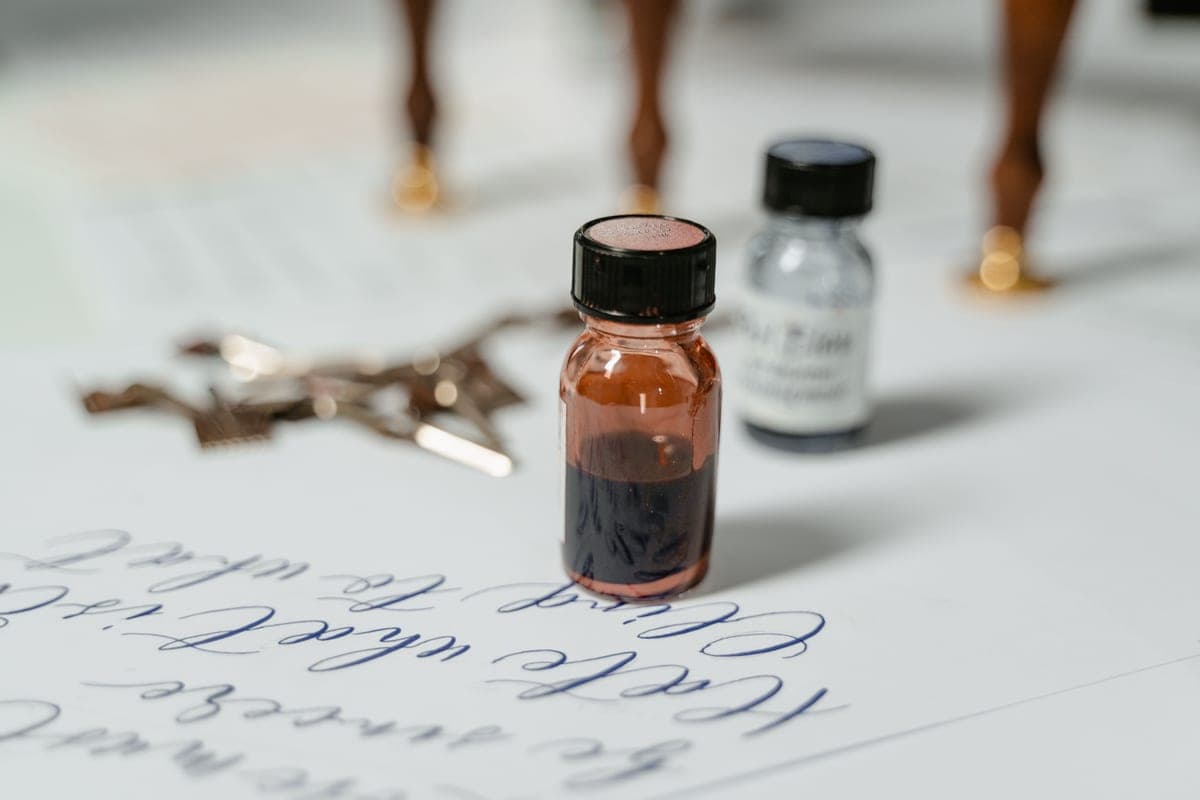
Which procedure you need depends on how your pen takes ink. If you are not sure, the compatibility guide identifies it by brand.
Fitting a cartridge
Cartridge, step by step
- 1
Unscrew the barrel from the section
The section is the part with the nib on it. Most pens separate at a thread just behind the grip.
- 2
Push the cartridge onto the nipple, narrow end first
Line it up and push firmly and straight. There is a small click as the seal is punctured. If it will not go, check you have the right cartridge for the brand — there is no adapter.
- 3
Screw the barrel back on and wait
Ink has to travel down the feed by capillary action, which takes a minute or two. Holding the pen nib-down speeds it up.
- 4
If it still will not start, squeeze gently
With the barrel off, a light squeeze on the cartridge pushes ink into the feed. One drop is enough — more will flood it.
Filling a converter
Converter, step by step
- 1
Fit the converter the same way a cartridge fits
It pushes onto the same nipple. Make sure it is fully seated or it will draw air instead of ink.
- 2
Twist the piston fully down before you start
Expelling the air first is what lets it draw a full fill. Doing this over the bottle rather than the desk is advisable.
- 3
Submerge the nib to just above the breather hole
The whole nib, not just the tip. The breather hole is the small round opening partway up the slit; the ink needs to be above it.
- 4
Twist the piston up slowly
Slowly matters. A fast draw pulls in air bubbles that occupy space you wanted for ink.
- 5
Expel two or three drops back into the bottle
This is the trick most people are never told. It removes the air pocket at the top of the converter, and it is what stops a freshly filled pen burping a blot onto the first line.
- 6
Wipe the nib and section before capping
A tissue or a paper towel. Ink left on the section ends up on your fingers and inside the cap.
Quick picks
Ranked for the beginner buying their first setup. Every pick names who it is wrong for.
| # | Product | Best for | Price |
|---|---|---|---|
| 1 |  Pilot CON-40 converter The screw converter that fits the widest range of Pilot pens, including the ones with narrow barrels. | Bottled ink in a Metropolitan or Kakuno | |
| 2 |  Waterman Serenity Blue, 50 ml The ink most often recommended as a first bottle because it is well behaved on ordinary paper and washes out of a pen easily. | The safest first bottle | |
| 3 |  TWSBI ECO A piston filler with a clear barrel at the price other brands charge for a cartridge pen, so the ink is visible and the refill is free. | Using bottled ink from day one | $38.99 · View on Amazon #ad Price as of October 18, 2026. How this is funded |
1. Bottled ink in a Metropolitan or Kakuno
Pilot CON-40 converter
The screw converter that fits the widest range of Pilot pens, including the ones with narrow barrels.
Pilot sells several converters and they are not interchangeable. The CON-40 is the small one that fits nearly everything; the CON-70 holds far more but only fits wider pens.
The CON-40 has agitator balls inside it, which look like a defect and are not — they stop ink clinging to the walls.
If you own a Metropolitan and want to use a bottle, this is the part.
| Type | Screw-type converterSource: Pilot CON-40 converter (retail listing, read 2026-09-01) |
|---|---|
| Fits | Pilot fountain pens that take the CON-40, including the Metropolitan and KakunoSource: Pilot CON-40 converter (retail listing, read 2026-09-01) |
| Capacity | Not published |
| Larger alternative | The CON-70, for pens with a wider barrelSource: Pilot CON-70 converter (retail listing, read 2026-09-01) |
What it does well
- Fits the widest range of Pilot pens
- Cheap enough to buy two
- Screw fitting will not fall out
What it does not
- Small capacity
- Not interchangeable with the CON-70
- Pilot does not publish the capacity
Skip this if your Pilot takes the larger CON-70 — buy that instead and get double the ink.
2. The safest first bottle
Waterman Serenity Blue, 50 ml
The ink most often recommended as a first bottle because it is well behaved on ordinary paper and washes out of a pen easily.
A first bottle should be forgiving in two ways: it should behave on the cheap paper you already own, and it should rinse out without a fight when you want to change color. Serenity Blue is chosen for both.
It is a straightforward dye ink with no shimmer, no pigment and no unusual additives. That is exactly what you want while you are still learning which problems are the pen, which are the ink and which are the paper.
Waterman does not publish a drying time or a water-resistance figure for it, and neither does anyone else selling it, so we do not quote one.
| Format | 50 ml bottleSource: Waterman Serenity Blue (retail listing, read 2026-09-01) |
|---|---|
| Type | Dye-based, for refillable fountain pensSource: Waterman Serenity Blue (retail listing, read 2026-09-01) |
| Published drying time | Not published |
| Published water resistance | Not published |
What it does well
- Easy to flush out of a pen when changing colors
- Standard dye ink with no unusual additives to complicate diagnosis
- Widely stocked, so it is easy to replace
What it does not
- Not water resistant — a wet page is a lost page
- The color is deliberately unremarkable
- No published performance figures of any kind
Skip this if you need writing that survives water, or if you want the ink itself to be the interesting part of the setup.
3. Using bottled ink from day one
TWSBI ECO
A piston filler with a clear barrel at the price other brands charge for a cartridge pen, so the ink is visible and the refill is free.
#ad Price as of October 18, 2026. How this is funded
A piston filler holds far more ink than a cartridge and costs nothing to refill after the first bottle. That combination usually starts at three times this price, which is why the ECO turns up on every beginner list that takes bottled ink seriously.
The clear barrel is not just decoration. You can see how much ink is left, which removes the most common beginner surprise: a pen that stops mid-sentence with no warning.
TWSBI's own guidance on choosing a nib is unusually plain: extra fine if you write small, fine for a normal hand, medium if you write large, broad for headings and signatures.
| Nib grades offered | Extra Fine, Fine, Medium, Broad, Stub 1.1Source: TWSBI, ECO product page (read 2026-09-01) |
|---|---|
| Nib width in mm | Not published |
| Filling | Built-in piston — unscrew the end cap, dip the nib, screw it backSource: TWSBI, ECO product page (read 2026-09-01) |
| Cap | Inner cap for a seal when stored; the cap posts on the barrelSource: TWSBI, ECO product page (read 2026-09-01) |
| Ink included | No — the pen ships emptySource: TWSBI, ECO product page (read 2026-09-01) |
What it does well
- Piston filler at a cartridge-pen price
- Clear barrel shows the ink level
- Five nib grades including a 1.1 mm stub
What it does not
- Requires a bottle of ink before it will write at all
- Clear plastic sections have a reputation for cracking if over-tightened
- No cartridge option, so it is not the pen to travel light with
Skip this if you want to write the day it arrives without also buying ink, or if you need cartridge convenience for a bag or a commute.
Filling a piston filler
Piston filler, step by step
- 1
Unscrew the blind cap at the end of the barrel
On a TWSBI ECO this is the whole end section; it stays attached and turns freely.
- 2
Twist it to drive the piston fully down
Same principle as the converter: expel the air first, and do it over the bottle.
- 3
Submerge the nib above the breather hole and twist back up
Slowly. A piston filler holds a great deal more than a converter, so a full draw takes longer.
- 4
Expel a few drops, then close the blind cap
Then wipe the nib and section thoroughly — a piston pen carries more ink and therefore more mess.
Common problems
| Problem | Usual cause | Fix |
|---|---|---|
| The converter only half fills | Drawn too fast, or the nib was not submerged far enough | Expel and repeat, slower and deeper |
| The pen blots on the first line | Air pocket at the top of the converter | Expel two or three drops back into the bottle |
| Nothing draws at all | Converter not fully seated on the nipple | Remove and refit firmly |
| Ink all over the section | Normal — this is why you wipe | Tissue, every time |
| The cartridge will not click on | Wrong cartridge for the brand | Check compatibility |
How much ink to keep in the pen
A full fill, if you use the pen regularly. Ink sitting in a pen for months is how you get a clog, particularly with pigment inks — so if you write occasionally, fill it and then use it, rather than filling it and putting it away.
When you do want to change ink, flush the pen first. Mixing residual ink with a new color at best muddies it and at worst precipitates solids.
Questions people actually ask
How do you fill a fountain pen from a bottle?
Fit a converter, twist the piston fully down, submerge the nib to just above the breather hole, twist slowly back up, then expel two or three drops back into the bottle and wipe the nib.
Why does my fountain pen blot on the first line after filling?
An air pocket at the top of the converter expands and pushes ink out. Expelling two or three drops back into the bottle immediately after filling removes it.
How deep should I submerge the nib when filling?
To just above the breather hole — the small round opening partway up the slit. Submerging only the tip means the converter draws air instead of ink.
How do I fill a piston filler?
Unscrew the blind cap at the end of the barrel, twist to drive the piston down, submerge the nib above the breather hole, twist slowly back up, expel a few drops and wipe thoroughly.
Should I fill a fountain pen completely?
Yes, if you use it regularly. If you write only occasionally, ink sitting in the pen for months risks a clog — fill it when you intend to use it rather than filling it to store it.