Guides
How to use a fountain pen
Two habits carried over from a ballpoint are responsible for most bad first experiences. Both are easy to unlearn.
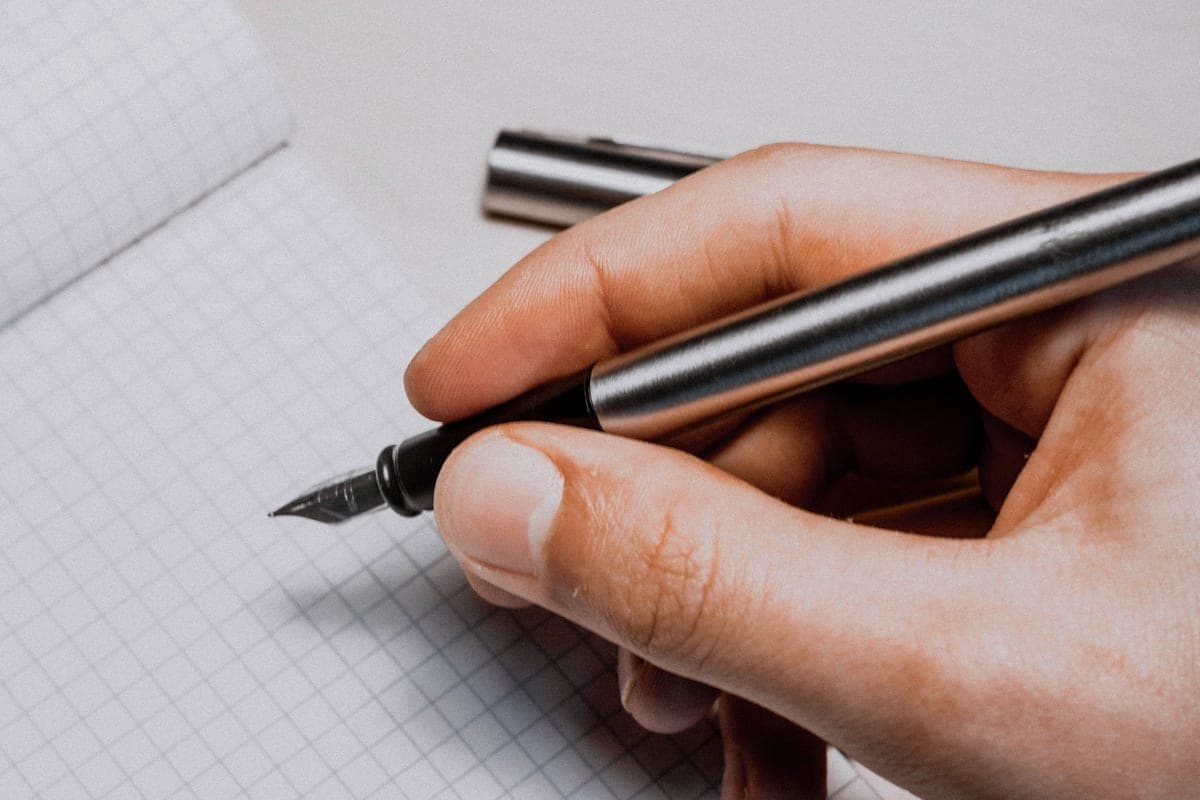
A ballpoint works by rolling a ball against the page, which requires downward force. A fountain pen works by capillary action, which requires contact and nothing else. Almost everything that goes wrong for a new user comes from applying ballpoint technique to a pen that does not want it.
The mechanics, in order
- 1
Hold it further back than you would a ballpoint
Grip roughly two to three centimeters from the tip, on the section rather than right at the nib. A grip too close to the nib forces the pen upright, and upright is the one angle a fountain pen cannot write at.
- 2
Write at about 45 degrees to the page
The nib has a flat top and a slit down the middle. It writes when that flat surface meets the paper at a shallow angle, which happens naturally at roughly 45 degrees. Too upright and only the tip touches; too flat and the nib scrapes.
- 3
Keep the nib the right way up
The engraved side faces the ceiling. Rotated even slightly, one tine contacts the paper before the other and the pen skips. Pens with a molded grip or a face on the nib exist specifically to prevent this.
- 4
Use no pressure at all
Rest the nib on the page and move it. That is the entire technique. Pressure spreads the tines, which changes the line width and, sustained, springs the nib permanently.
- 5
Move your arm, not just your fingers
Because there is no downward force to fight, a fountain pen rewards writing from the shoulder and elbow rather than gripping and pushing with the fingers. This is where the reduced hand fatigue actually comes from.
- 6
Cap it when you stop
An uncapped nib dries in minutes and stops writing. Cap it even for a short pause; store it nib up if it will sit for days.
The two habits to unlearn
Pressing
Everyone presses. Twenty years of ballpoints teaches the hand that pressure makes ink. With a fountain pen it makes a wider, wetter line, more feathering, and eventually a sprung nib.
The test: write a line normally, then write one resting the pen on the page with no force at all. If the second line is thinner and cleaner, you were pressing.
Rotating
Many people roll a ballpoint slightly as they write, which a ball tolerates and a nib does not. If your pen writes for half a sentence then skips, check whether the nib is still facing up at the end of the line.
Quick picks
Ranked for the beginner buying their first setup. Every pick names who it is wrong for.
| # | Product | Best for | Price |
|---|---|---|---|
| 1 |  LAMY Safari A molded triangular grip forces the pen into the right position, which is either the best or the worst thing about it. | Learning a correct grip | $30.95 · View on Amazon #ad Price as of October 18, 2026. How this is funded |
| 2 |  Faber-Castell Grip 2011 A textured grip of molded dots that gives a light, secure hold without forcing your fingers into a fixed position. | Hands that get tired quickly | $28.25 · View on Amazon #ad Price as of October 18, 2026. How this is funded |
1. Learning a correct grip
LAMY Safari
A molded triangular grip forces the pen into the right position, which is either the best or the worst thing about it.
#ad Price as of October 18, 2026. How this is funded
The grip section is the entire argument. It is molded into a triangle, so there is exactly one way to hold the pen, and it happens to be the way that keeps the nib flat against the paper. For someone who has spent twenty years white-knuckling a ballpoint, that is a genuine teaching aid.
It is also the reason some people hate it. If your natural grip is unusual, the Safari will fight you every time you pick it up, and no amount of practice makes a molded plastic triangle move.
Everything else about the pen is deliberately easy. The nib pulls off and pushes on by hand, so if you buy a Fine and want a Medium later, that is a five-dollar part rather than a new pen.
| Nib grades offered | Extra Fine, Fine, Medium, Broad, plus a dedicated left-hander nibSource: LAMY Safari, Fine (retail listing, read 2026-09-01) |
|---|---|
| Nib width in mm | Not published |
| Nib | Interchangeable steel nib unit — pulls off and swaps without toolsSource: LAMY Safari, Fine (retail listing, read 2026-09-01) |
| Filling | LAMY T10 proprietary cartridge, or the LAMY Z28 converterSource: LAMY Z28 converter (retail listing, read 2026-09-01) |
| Body | ABS plastic with a molded triangular grip sectionSource: LAMY Safari, Fine (retail listing, read 2026-09-01) |
What it does well
- Swappable nib units mean one pen can change its line width
- A dedicated left-handed nib grade exists, which is rare
- Nearly indestructible plastic body
What it does not
- The triangular grip is not optional and does not suit every hand
- LAMY cartridges are proprietary — the Z28 converter is a separate buy
- German Fine is wider than a Japanese Fine, which surprises people
Skip this if you hold a pen unconventionally, or if your handwriting is small enough that a German Fine will fill in your loops.
2. Hands that get tired quickly
Faber-Castell Grip 2011
A textured grip of molded dots that gives a light, secure hold without forcing your fingers into a fixed position.
#ad Price as of October 18, 2026. How this is funded
The dot pattern is the point. It gives grip through friction rather than through shape, so unlike the LAMY triangle it does not dictate how you hold the pen — it just stops the pen sliding when your hand relaxes.
That matters most for long writing sessions. Most hand fatigue comes from gripping harder than necessary, and a barrel that does not need to be squeezed is a real fix.
It uses international standard cartridges, so refills are not tied to the brand.
| Nib | Steel, FineSource: Faber-Castell Grip 2011, Fine (retail listing, read 2026-09-01) |
|---|---|
| Filling | International standard cartridgeSource: Faber-Castell standard ink cartridges (retail listing, read 2026-09-01) |
| Body | Metal barrel with a molded dot grip patternSource: Faber-Castell Grip 2011, Fine (retail listing, read 2026-09-01) |
| Nib width in mm | Not published |
What it does well
- Grip works without constraining hand position
- International standard cartridges
- Metal body at a moderate price
What it does not
- The dotted texture is a strong visual style
- Less widely stocked in the US than Pilot or LAMY
- No published nib width
Skip this if you already grip lightly and want the thinnest possible line — this is a comfort pen, not a precision one.
What good writing feels like
Slightly wet, slightly slippery, and quieter than a ballpoint. There should be almost no resistance. A faint feedback texture is normal and preferred by some; scratchiness that catches on the upstroke is not, and usually means the nib is rotated or the paper is poor.
If it still will not write
Work through troubleshooting in order. The vast majority of new-pen problems are a dry start, a rotated nib, or paper that is fighting the ink — in that order of likelihood.
Questions people actually ask
How do you hold a fountain pen correctly?
Grip the section two to three centimeters from the tip, keep the engraved side of the nib facing up, and write at roughly 45 degrees to the page. Further back than a ballpoint, and with no downward pressure.
How much pressure should I use with a fountain pen?
None. Rest the nib on the page and move it. Pressure spreads the tines, widens the line and can permanently spring the nib.
Why does my fountain pen skip when I write?
Most often because the nib has rotated so one tine touches before the other. Check the engraved side is still facing up at the end of a line. The troubleshooting guide covers the other causes.
What angle should I hold a fountain pen at?
About 45 degrees to the page. Too upright and only the tip contacts; too flat and the nib scrapes. Holding the pen further back on the section makes the right angle happen naturally.
Do I need to cap a fountain pen between sentences?
For a short pause, no. For anything longer than a minute or two, yes — an uncapped nib begins drying within minutes and a dry start is the most common reason a pen appears to have stopped working.