Ink
The best blue fountain pen inks
Blue is the color people choose without thinking and then discover covers everything from a pale, forgiving everyday ink to a permanent pigment. The name on the bottle rarely tells you which.
How this page is funded. Buying through a link here earns us a commission at no extra cost to you. It does not change what we recommend or the order we recommend it in, and we have not hands-on tested these products — see how we choose and the full disclosure.
Blue is the default fountain pen color for good reasons. It reads clearly, it separates your handwriting from printed black text at a glance, and the everyday blues are among the most forgiving inks made. It is also the color with the widest spread of behavior hiding behind similar-looking bottles.
Two blue inks at the same price can differ in how much liquid they put on the page, how they look on good paper against bad, and - most importantly - whether the writing survives a spilled glass of water. None of that is visible in the bottle, and very little of it is printed on the label.
Five kinds of blue, and what separates them
It helps to sort blue inks by what they do rather than by shade. The categories below are the ones that change your experience; the exact hue within each is the least important decision you will make.
| Kind | What it does | On this page |
|---|---|---|
| Everyday blue | Well behaved on ordinary paper and easy to rinse out of a pen. The safest possible first fill. | Waterman Serenity Blue |
| Dry blue | Puts comparatively little ink on the page, so it stays crisp on absorbent paper - and can feel scratchy in a pen that already writes dry. | Pelikan 4001 Royal Blue |
| Saturated blue | Flows generously and shades on good paper. Looks its best on coated stock and shows through thin pages. | Pilot Iroshizuku Kon-peki |
| Blue-black | A darker, more formal color. On its own the name says nothing about permanence. | Diamine Blue-Black, Parker Quink Blue-Black |
| Permanent blue | A pigment formulation that stays put when the page gets wet, at the cost of harder cleaning. | Sailor pigment blue |
Only one row on that table is about chemistry rather than color, and it is the one that matters most if the writing needs to last. Everything else is a question of how the ink suits your pen and your paper.
How we ranked these
- Safety on paper you have not tested first. Most people buying a blue do not own specialist paper, so an ink that behaves on whatever is in the drawer is worth more than one that looks spectacular on Rhodia.
- Then what the maker publishes. A stated volume, a stated formulation, a stated range. Several of these listings publish almost nothing beyond volume and color, and the picks say so.
- Then what each one is for. Six blues that all did the same job would be a useless list, so each pick answers a different need.
- Cost per milliliter as a tiebreaker, since blue is the color people go through fastest.
- No lab testing. We publish no drying times or water-resistance figures of our own, here or anywhere on the site.
The inks
Quick picks
Ranked for the beginner buying their first setup. Every pick names who it is wrong for.
| # | Product | Best for | Price |
|---|---|---|---|
| 1 |  Waterman Serenity Blue, 50 ml The ink most often recommended as a first bottle because it is well behaved on ordinary paper and washes out of a pen easily. | The safest first bottle | |
| 2 |  Pelikan 4001 Royal Blue, 62.5 ml A dry-writing classic that lays down less ink than most, which is exactly what cheap paper needs. | Thin, absorbent paper | |
| 3 | 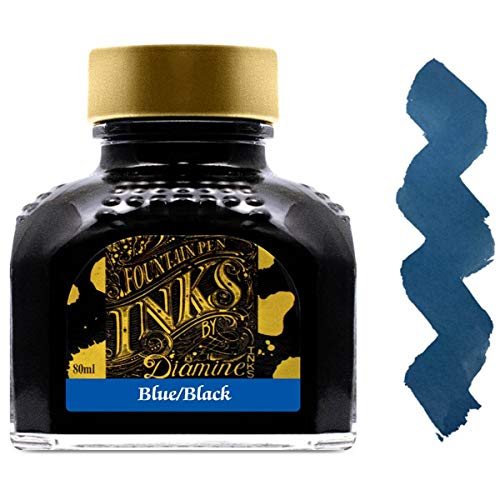 Diamine Blue-Black, 80 ml Eighty milliliters of an everyday blue-black - the big-bottle pick, as long as you do not read the name as a promise of permanence. | The largest bottle of blue-black here | $30.95 · View on Amazon #ad Price as of October 18, 2026. How this is funded |
| 4 |  Pilot Iroshizuku Kon-peki, 50 ml A deep azure blue that flows generously and shades from pale to dark within a single stroke on good paper. | The first bottle worth being excited about | $18.80 · View on Amazon #ad Price as of October 18, 2026. How this is funded |
| 5 |  Parker Quink Blue-Black, 57 ml Parker's everyday blue-black in a 57 ml bottle - unremarkable in the way a reliable default should be. | A conventional everyday blue-black | |
| 6 |  Sailor pigment ink, blue, 50 ml Sailor's pigment ink in blue - the permanent choice on this page, with the cleaning discipline every pigment ink demands. | A blue that survives getting wet | $17.70 · View on Amazon #ad Price as of October 18, 2026. How this is funded |
1. The safest first bottle
Waterman Serenity Blue, 50 ml
The ink most often recommended as a first bottle because it is well behaved on ordinary paper and washes out of a pen easily.
A first bottle should be forgiving in two ways: it should behave on the cheap paper you already own, and it should rinse out without a fight when you want to change color. Serenity Blue is chosen for both.
It is a straightforward dye ink with no shimmer, no pigment and no unusual additives. That is exactly what you want while you are still learning which problems are the pen, which are the ink and which are the paper.
Waterman does not publish a drying time or a water-resistance figure for it, and neither does anyone else selling it, so we do not quote one.
| Format | 50 ml bottleSource: Waterman Serenity Blue (retail listing, read 2026-09-01) |
|---|---|
| Type | Dye-based, for refillable fountain pensSource: Waterman Serenity Blue (retail listing, read 2026-09-01) |
| Published drying time | Not published |
| Published water resistance | Not published |
What it does well
- Easy to flush out of a pen when changing colors
- Standard dye ink with no unusual additives to complicate diagnosis
- Widely stocked, so it is easy to replace
What it does not
- Not water resistant — a wet page is a lost page
- The color is deliberately unremarkable
- No published performance figures of any kind
Skip this if you need writing that survives water, or if you want the ink itself to be the interesting part of the setup.
2. Thin, absorbent paper
Pelikan 4001 Royal Blue, 62.5 ml
A dry-writing classic that lays down less ink than most, which is exactly what cheap paper needs.
A dry ink is not a defect. Less ink leaving the nib per centimeter of line means less ink for absorbent paper to wick sideways, which is why a dry ink on bad paper often looks sharper than a wet ink on good paper.
4001 is the reference point for that behavior. If you are stuck writing on photocopier paper or a school notebook, this is the pairing that has the best chance of staying crisp.
The trade is on good paper, where a dry ink can feel scratchy and looks thin next to something more saturated.
| Format | 62.5 ml bottleSource: Pelikan 4001 Royal Blue (retail listing, read 2026-09-01) |
|---|---|
| Range | 4001, Pelikan's long-running everyday ink lineSource: Pelikan 4001 Royal Blue (retail listing, read 2026-09-01) |
| Published drying time | Not published |
| Published water resistance | Not published |
What it does well
- Runs dry, which suits thin and absorbent paper
- Large bottle for the money
- Long-established formula that is easy to replace anywhere
What it does not
- Can feel scratchy in an already-dry pen
- Color is pale next to modern saturated inks
- No published figures for drying or water resistance
Skip this if your pen already writes dry — pairing a dry ink with a dry nib is how people conclude they hate fountain pens.
3. The largest bottle of blue-black here
Diamine Blue-Black, 80 ml
Eighty milliliters of an everyday blue-black - the big-bottle pick, as long as you do not read the name as a promise of permanence.
#ad Price as of October 18, 2026. How this is funded
The listing states the volume and the color and nothing else, which is normal for Diamine. The useful number is the arithmetic: 80 ml is the largest bottle on this page, against 50 to 62.5 ml for the others.
Blue-black here is a color, not a chemistry. The listing makes no water-resistance claim, so treat it as an ordinary ink - fine in a notebook, not for anything that might get wet.
If you like Diamine's behavior but want a brighter blue, the same range covers dozens of them, and the Diamine profile is the place to browse.
| Volume | 80 ml bottleSource: Diamine Blue-Black, 80 ml (retail listing, read 2026-10-10) |
|---|---|
| Color | Blue/BlackSource: Diamine Blue-Black, 80 ml (retail listing, read 2026-10-10) |
| Water resistance | Not published |
| Drying time | Not published |
What it does well
- The largest bottle on this page
- Dark enough to read as a serious everyday color
- Part of a very large range if you want to change color later
What it does not
- The listing publishes nothing beyond volume and color
- 80 ml is a long commitment to one ink
- No water resistance claimed
Skip this if blue-black appeals because you assume it is permanent. Nothing on this listing says so; the Sailor pigment blue is the one on this page built for that job.
4. The first bottle worth being excited about
Pilot Iroshizuku Kon-peki, 50 ml
A deep azure blue that flows generously and shades from pale to dark within a single stroke on good paper.
#ad Price as of October 18, 2026. How this is funded
Iroshizuku is where most people discover that ink can be interesting. Kon-peki shades — the same stroke goes light where the ink pooled less and dark where it pooled more — and that variation is what makes handwriting look considered rather than printed.
It is a wet ink. On the 70 gsm paper in a supermarket notebook it will show through, and on the worst paper it will bleed. Pair it with 90 gsm or better and it behaves.
It costs several times what a bottle of everyday blue costs, and it will last you a year of daily writing regardless.
| Format | 50 ml bottleSource: Pilot Iroshizuku Kon-peki (retail listing, read 2026-09-01) |
|---|---|
| Color | Kon-peki, deep azure blueSource: Pilot Iroshizuku Kon-peki (retail listing, read 2026-09-01) |
| Behavior noted in the listing | Shading and sheen, most visible with broader nibsSource: Pilot Iroshizuku Kon-peki (retail listing, read 2026-09-01) |
| Published drying time | Not published |
What it does well
- Genuine shading that rewards good paper
- Flows generously in dry-writing nibs
- One bottle lasts a very long time
What it does not
- Wet flow means bleed-through on thin paper
- Several times the price of an everyday blue
- Not water resistant
Skip this if the paper you actually write on is thin office stock — a wet ink on absorbent paper wastes the ink and ruins the page.
5. A conventional everyday blue-black
Parker Quink Blue-Black, 57 ml
Parker's everyday blue-black in a 57 ml bottle - unremarkable in the way a reliable default should be.
The reason to buy Quink is that it is ordinary in the useful sense: a conventional everyday ink with no unusual properties to complicate diagnosing a pen that misbehaves.
One detail on Parker's own range is worth reading carefully. Parker sells a separate Quink labeled Washable Blue. The blue-black listing carries no such word, so we do not describe it as washable - if easy removal from fabric matters to you, buy the one that says so.
No drying time or water-resistance figure is published.
| Volume | 57 ml bottleSource: Parker Quink Blue-Black, 57 ml (retail listing, read 2026-09-17) |
|---|---|
| Color | Blue-BlackSource: Parker Quink Blue-Black, 57 ml (retail listing, read 2026-09-17) |
| Range | Quink, sold as a fountain pen refillSource: Parker Quink Blue-Black, 57 ml (retail listing, read 2026-09-17) |
| Washable | Not published |
| Water resistance | Not published |
| Drying time | Not published |
What it does well
- A conventional ink with nothing unusual to troubleshoot
- Sold as a standard fountain pen refill from a major maker
- A distinct blue-black that reads well on a printed page
What it does not
- Almost nothing about the ink is published
- Not described as washable, unlike Parker's Washable Blue
- 57 ml, against 80 ml in the Diamine blue-black
Skip this if you want the ink to be the interesting part of the setup. It is a dependable default, and Iroshizuku Kon-peki is the blue on this page for people who want more.
6. A blue that survives getting wet
Sailor pigment ink, blue, 50 ml
Sailor's pigment ink in blue - the permanent choice on this page, with the cleaning discipline every pigment ink demands.
#ad Price as of October 18, 2026. How this is funded
This is the blue sibling of the Sailor pigment black this site already covers. Pigment inks suspend solid particles rather than dissolving a dye, which is what makes them permanent and water resistant once dry - the property none of the other blues on this page claims.
The listing states pigment but publishes no water-resistance rating, so we describe the chemistry rather than quoting a figure Sailor does not give.
The cost is the one every pigment ink carries. Those particles can settle and dry inside a feed, so keep it in a pen you use regularly and flush it properly when you change inks.
| Type | Pigment inkSource: Sailor pigment bottle ink, blue, 50 ml (retail listing, read 2026-09-17) |
|---|---|
| Volume | 50 ml bottleSource: Sailor pigment bottle ink, blue, 50 ml (retail listing, read 2026-09-17) |
| Color | BlueSource: Sailor pigment bottle ink, blue, 50 ml (retail listing, read 2026-09-17) |
| Maker's product code | 13-2002-242Source: Sailor pigment bottle ink, blue, 50 ml (retail listing, read 2026-09-17) |
| Water-resistance rating | Not published |
| Drying time | Not published |
What it does well
- Pigment formulation, so writing survives water once dry
- The only permanent blue on this page
- Same pigment approach as Sailor's black, if you use both
What it does not
- Will clog a pen left standing, like all pigment inks
- No published water-resistance rating or drying time
- Demands more careful cleaning than any dye blue here
Skip this if you are prone to forgetting pens in a drawer for a month. A dye blue like Waterman Serenity Blue forgives that; a pigment ink does not.
What blue-black actually tells you
Less than it sounds like it should, and this is the single most useful thing on the page.
Blue-black is a color name. It describes a dark blue with a lot of black in it, and on the two blue-blacks here - Diamine's and Parker's - it describes nothing else. Neither listing claims water resistance or permanence. They are ordinary inks in a darker shade.
If you want a blue that survives water, look for a formulation word, not a color word. On this page that word is pigment, and it appears on one listing only: the Sailor. The other permanent chemistry you will see mentioned is iron gall, which is genuinely permanent and genuinely capable of corroding a nib left standing - real, and not where a beginner should start, as the waterproof ink page explains.
Washable is a feature, not a weakness
Parker's own range shows the distinction neatly. It sells a Quink explicitly labeled Washable Blue alongside the Blue-Black that carries no such label. Washability is a property a maker chooses to claim, not something you can assume from the color.
And it is a real benefit, not a lesser version of permanent ink. An ink that is designed to wash out is an ink that forgives a spill on a shirt or a child using the pen. The trade is the obvious one: an ink that washes out is not an ink that survives getting wet on the page. You cannot have both properties in one bottle.
The practical answer for most people is two bottles eventually - an everyday blue that forgives everything, and a permanent one for the handful of things that need to last.
Matching the blue to your paper
This is where people are most often disappointed, and it runs the same way for blue as for every other color.
| If you write on | Buy | Because |
|---|---|---|
| Office paper, school notebooks, a Moleskine | Pelikan 4001 Royal Blue | A dry ink puts less liquid on absorbent paper, so there is less to feather and less to soak through. |
| Rhodia, Clairefontaine, Tomoe River | Pilot Iroshizuku Kon-peki | Coated paper holds a wet ink at the surface, which is where its shading shows. |
| Anything that might get wet | Sailor pigment blue | The only formulation here that is built to stay put in water. |
| You do not know yet | Waterman Serenity Blue | Forgiving on most paper and easy to rinse out while you find out what you like. |
If your paper is fighting you, the inks for cheap paper page goes further on that problem, and the bleed, ghosting and feathering guide explains which of the three failures you are actually seeing.
Blue or black?
Both are sensible, and the choice is more practical than aesthetic.
- Blue separates your writing from print. Notes in the margin of a printed page, corrections on a draft, signatures on a form - blue is legible against black type where black ink disappears into it.
- The everyday blues tend to be forgiving. They are usually less saturated than a dense black, which puts less on the page and gives cheap paper an easier time.
- Black reads as more formal, and the densest blacks look sharper on good paper.
- Blue-black splits the difference - serious enough for anything, still distinguishable from print.
If you are leaning toward black after all, the black ink comparison sorts those by the same properties this page uses, so the two can be read side by side.
Bottle size, briefly
The bottles here run from 50 ml to 80 ml. For a first bottle, the smaller end is the better buy, because you do not yet know whether you like the ink.
Buy the 80 ml Diamine once a blue-black has earned it. A large bottle only saves money on an ink you were going to use up anyway.
If you are on cartridges
Everything above assumes bottled ink, because that is where the choice exists. Cartridge users are limited to whatever their pen's maker sells in its own format - Pilot, LAMY and Platinum each use a proprietary cartridge, and only the international standard has a real third-party market.
For Pilot pens, the IC-100 blue-black cartridges this site covers are a sensible default. The cartridge page covers what fits which pen, and cartridge versus converter covers whether it is worth moving to a bottle at all. If the second bottle is for marking up rather than writing, the red ink roundup covers that job specifically.
Questions people actually ask
What is the best blue fountain pen ink?
For a first bottle, Waterman Serenity Blue - it behaves on most paper and rinses out easily. For cheap or thin paper, Pelikan 4001 Royal Blue, which writes dry. For good paper, Pilot Iroshizuku Kon-peki. For writing that must survive water, a pigment ink such as Sailor's pigment blue.
Is blue-black fountain pen ink permanent?
Not because of the name. Blue-black is a color, and neither the Diamine nor the Parker blue-black listing claims water resistance. Permanence comes from the formulation - pigment, or iron gall - and a listing that does not say so should be assumed to run when wet.
Which blue ink is best for cheap paper?
A dry one. Pelikan 4001 Royal Blue puts comparatively little ink on the page, which is the mechanism that reduces feathering and bleed-through on absorbent paper. A wet, saturated blue like Kon-peki will show through thin pages.
Is there a waterproof blue fountain pen ink?
Pigment blues are the water-resistant option, and Sailor's pigment ink in blue is the one on this page. It publishes no water-resistance rating, and like every pigment ink it can clog a pen left standing, so keep it in a pen you use regularly.
Should I use blue or black fountain pen ink?
Blue if your writing sits alongside printed text, since it stays distinguishable from black type. Black if you want the most formal look. Blue-black splits the difference. The everyday blues also tend to be more forgiving on cheap paper than a dense black.
What is the difference between royal blue and blue-black?
Color only. Royal blue is a bright mid-blue; blue-black is darker with more black in it. Neither name tells you anything about water resistance, drying time or how the ink behaves on paper - those depend on the formulation.
Sources
- Waterman Serenity Blue (retail listing, read 2026-09-01)
- Pelikan 4001 Royal Blue (retail listing, read 2026-09-01)
- Pilot Iroshizuku Kon-peki (retail listing, read 2026-09-01)
- Diamine Blue-Black, 80 ml (retail listing, read 2026-10-10)
- Parker Quink Blue-Black, 57 ml (retail listing, read 2026-09-17)
- Sailor pigment bottle ink, blue, 50 ml (retail listing, read 2026-09-17)
- Parker Quink Washable Blue, 57 ml (retail listing, read 2026-09-17)