Ink
The best red fountain pen inks
Red is the only color with a job attached. Most people buy it to mark something, and that one fact should decide which red you get.
How this page is funded. Buying through a link here earns us a commission at no extra cost to you. It does not change what we recommend or the order we recommend it in, and we have not hands-on tested these products — see how we choose and the full disclosure.
Blue and black are the colors people write in. Red is the color people write with - corrections, annotations, a line through something that is finished. It is the one color on this site that usually has a task attached rather than a preference.
That changes the buying question. A red for marking up a printed page has to do something a journaling red does not: stay legible against black type, on cheap paper, and dry before your hand moves over it.
Two jobs, two different reds
Almost every disappointment in this category comes from buying one when you needed the other.
| If the red is for | You want | Because |
|---|---|---|
| Marking, correcting, annotating | A bright, dry red | It has to separate from black print at a glance and dry before your hand crosses it. |
| Writing whole entries | A dark, characterful red | A bright corrective red is tiring to read across a full page. |
| Both, on one budget | The bright one | A dark red cannot do the marking job; a bright red can be written with, badly. |
The distinction matters because the shades at each end look similar in a swatch photograph and behave completely differently on a page of printed text.
How we ranked these
- Legibility against print first, since that is what most red is bought for. A red that disappears into black type has failed at its main job.
- Then drying time, where the maker states one. Red lives in margins, and margins get touched.
- Then behavior on ordinary paper, because annotation happens on whatever was printed rather than on good stock.
- Then what the maker actually publishes. Two of these five state real characteristics; the rest publish a volume and a color.
- No lab testing. We publish no drying times or water-resistance figures of our own, here or anywhere on the site.
The inks
Quick picks
Ranked for the beginner buying their first setup. Every pick names who it is wrong for.
| # | Product | Best for | Price |
|---|---|---|---|
| 1 | 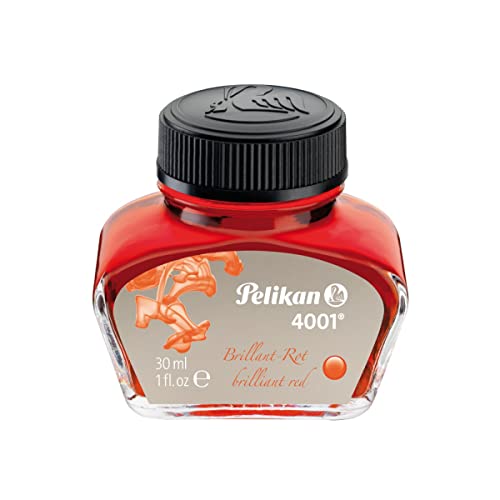 Pelikan 4001 Brilliant Red, 30 ml The 4001 formula in red - dry, thin and well behaved, which is what you want from a color you may only use for marking. | The safe red, and the cheapest one here | |
| 2 |  J. Herbin Rouge Caroubier, 30 ml A natural-dye red whose maker states it is fast drying and pH neutral - the most specific claims any red on this page carries. | A classic French red that dries fast | $14.58 · View on Amazon #ad Price as of October 18, 2026. How this is funded |
| 3 |  Diamine Poppy Red The brightest red here, from a listing that cannot decide what size bottle it is selling. | A bright, unambiguous red | |
| 4 |  Diamine Writer's Blood, 80 ml A deep, almost-brown red in a large textured glass bottle - the one to buy if red should look serious rather than corrective. | The dark red people actually mean by blood red | $19.85 · View on Amazon #ad Price as of October 18, 2026. How this is funded |
| 5 |  Pilot Iroshizuku Momiji, 50 ml Iroshizuku's autumn-leaves red - the one that shades on good paper, at several times the price of an everyday bottle. | The red you buy to look at |
1. The safe red, and the cheapest one here
Pelikan 4001 Brilliant Red, 30 ml
The 4001 formula in red - dry, thin and well behaved, which is what you want from a color you may only use for marking.
This is the same 4001 formula this site recommends as a first bottle in blue, black and green, and the reasoning carries over: it is thin, dry and low-saturation, which is the behavior that keeps ordinary paper legible.
For red specifically that matters more than usual. Red is the color most often used in margins and on printed pages - exactly the cheap, absorbent paper where a saturated ink feathers into a smear.
Pelikan publishes no drying time and no water-resistance claim, so we make neither. It is an ordinary dye ink.
| Volume | 30 mlSource: Pelikan 4001 Brilliant Red, 30 ml (retail listing, read 2026-09-22) |
|---|---|
| Formula age | Developed over 125 years ago, per the makerSource: Pelikan 4001 Brilliant Red, 30 ml (retail listing, read 2026-09-22) |
| Compatibility | Pelikan pens and other brands with a plunger or converter, per the makerSource: Pelikan 4001 Brilliant Red, 30 ml (retail listing, read 2026-09-22) |
| Made in | GermanySource: Pelikan 4001 Brilliant Red, 30 ml (retail listing, read 2026-09-22) |
| Water resistance | Not published |
| Drying time | Not published |
What it does well
- The least expensive red here
- Dry behavior suits marking up printed pages
- The same well-understood formula as the 4001 blue and black
What it does not
- Pale next to a saturated modern red
- Can feel scratchy in a pen that already writes dry
- No published figures for drying or water resistance
Skip this if you want red to look rich on the page. This is the practical one; Iroshizuku Momiji is the one you buy to look at.
2. A classic French red that dries fast
J. Herbin Rouge Caroubier, 30 ml
A natural-dye red whose maker states it is fast drying and pH neutral - the most specific claims any red on this page carries.
#ad Price as of October 18, 2026. How this is funded
J. Herbin states more about this ink than most makers state about any of theirs: water based, natural dyes, pH neutral, and fast drying. Those are claims rather than measurements, but they are at least specific claims.
Fast drying is the one that matters for red, because red is a margin color and margins get touched. It is also the reason this is the red to consider if you are left-handed - the inks for left-handers page covers why drying time beats everything else.
The cartridge note on the listing is unusually useful and worth reading if you were planning to buy the cartridge version: it names eight brands the international standard does not fit, which matches the compatibility guide on this site.
| Volume | 30 ml bottleSource: J. Herbin Rouge Caroubier, 30 ml (retail listing, read 2026-09-22) |
|---|---|
| Formulation | Water based, all natural dyes, non-toxic and pH neutralSource: J. Herbin Rouge Caroubier, 30 ml (retail listing, read 2026-09-22) |
| Drying | Flows smoothly and is fast drying, per the makerSource: J. Herbin Rouge Caroubier, 30 ml (retail listing, read 2026-09-22) |
| Also sold as | 10 ml, 30 ml and 100 ml bottles, or a tin of six cartridgesSource: J. Herbin Rouge Caroubier, 30 ml (retail listing, read 2026-09-22) |
| Cartridge fit | International standard short cartridges, which the maker states do not fit Sheaffer, Parker, Lamy, Cross, Pilot/Namiki, Sailor, Platinum or AuroraSource: J. Herbin Rouge Caroubier, 30 ml (retail listing, read 2026-09-22) |
| Water resistance | Not published |
What it does well
- The maker publishes real characteristics, not just a volume
- Stated fast drying, which suits a margin color
- Sold in three bottle sizes and in cartridges
What it does not
- No water-resistance claim
- A 30 ml bottle costs more than twice the Pelikan
- Natural dyes mean batch-to-batch variation is possible
Skip this if you need the ink to survive water. Nothing on this listing claims that, and no red on this page does.
3. A bright, unambiguous red
Diamine Poppy Red
The brightest red here, from a listing that cannot decide what size bottle it is selling.
Start with the contradiction, because it affects what you are paying per milliliter: the title sells an 80 ml bottle and the bullets describe a 30 ml plastic one. We cannot resolve that from the listing, so check the size on the page before you buy.
The ink itself is the bright, saturated red this category is usually searched for - the one that is unmistakably red rather than maroon or brown.
Bright and saturated also means more colorant on the page, so this is the red most likely to show through thin paper and the one most likely to stain a clear pen.
| Volume | Contradictory on the listing: the title says 80 ml, the feature bullets say a 30 ml plastic bottleSource: Diamine Poppy Red (retail listing, read 2026-09-22) |
|---|---|
| Formulation | Water-based, non-toxic, pH neutral, made from natural dyesSource: Diamine Poppy Red (retail listing, read 2026-09-22) |
| Drying | Fast drying and smooth flowing, per the makerSource: Diamine Poppy Red (retail listing, read 2026-09-22) |
| Maker's suggested use | Suitable for all brands of fountain pen; described as a calligraphy starter inkSource: Diamine Poppy Red (retail listing, read 2026-09-22) |
| Water resistance | Not published |
What it does well
- The brightest, most unambiguous red here
- Maker states fast drying and a pH neutral formulation
- Described as suitable for all brands of fountain pen
What it does not
- The listing contradicts itself on bottle size
- Saturated, so it shows through thin paper more than the others
- No water resistance claimed
Skip this if you own a demonstrator you care about. Bright saturated reds are the classic staining ink, and a tint in clear plastic does not come out.
4. The dark red people actually mean by blood red
Diamine Writer's Blood, 80 ml
A deep, almost-brown red in a large textured glass bottle - the one to buy if red should look serious rather than corrective.
#ad Price as of October 18, 2026. How this is funded
Writer's Blood is the dark end of red - deep enough that it reads as a considered color rather than a correction, which is what most people searching for a blood red actually want.
Eighty milliliters is a lot of a strongly characterful color. That is the trade with this one: the cost per milliliter is good and the commitment is long.
Diamine states fast drying and natural dyes here, which is more than its bottles usually say - the Diamine profile covers what the range is generally for.
| Volume | 80 ml textured glass bottleSource: Diamine Writer's Blood, 80 ml (retail listing, read 2026-09-22) |
|---|---|
| Formulation | Water-based, made from natural dyesSource: Diamine Writer's Blood, 80 ml (retail listing, read 2026-09-22) |
| Drying | Fast drying, per the makerSource: Diamine Writer's Blood, 80 ml (retail listing, read 2026-09-22) |
| Intended use | Fountain or dip pens and mixed mediaSource: Diamine Writer's Blood, 80 ml (retail listing, read 2026-09-22) |
| Water resistance | Not published |
What it does well
- Dark enough to use as a main writing color
- The largest bottle on this page
- Maker states fast drying and a water-based formulation
What it does not
- 80 ml is a long commitment to a distinctive shade
- Too dark if you wanted red to stand out on a page
- No water resistance claimed
Skip this if the red is for marking corrections. A dark red does not separate from black text at a glance, which is the entire job there.
5. The red you buy to look at
Pilot Iroshizuku Momiji, 50 ml
Iroshizuku's autumn-leaves red - the one that shades on good paper, at several times the price of an everyday bottle.
Iroshizuku is where people discover that ink can be interesting rather than functional, and Momiji is the red end of that. It shades - the same stroke goes lighter where less ink pooled - which is the property the range is bought for.
That shading needs coated paper to show. On the office stock where red ink usually lives, a wet Iroshizuku will show through and the shading will be lost, which makes this a poor choice for margin work.
The listing is almost entirely marketing: no drying time, no water resistance, no flow figure. The Iroshizuku profile covers what the premium actually buys.
| Volume | 50 ml bottleSource: Pilot Iroshizuku Momiji, 50 ml (retail listing, read 2026-09-22) |
|---|---|
| Color | Momiji, autumn leaves (red)Source: Pilot Iroshizuku Momiji, 50 ml (retail listing, read 2026-09-22) |
| Range | Iroshizuku, with color names drawn from Japanese landscapes and plantsSource: Pilot Iroshizuku Momiji, 50 ml (retail listing, read 2026-09-22) |
| Water resistance | Not published |
| Drying time | Not published |
What it does well
- Genuine shading on good paper
- A distinctly warm red rather than a corrective one
- One bottle lasts a very long time
What it does not
- Several times the price of an everyday red
- Wet flow shows through thin paper
- The listing publishes no performance figures at all
Skip this if the red is for correcting or annotating. It is a journaling ink, and Pelikan's Brilliant Red does the margin job for a fifth of the money.
Red stains clear pens, permanently
This is the one warning that belongs on every red ink page and appears on almost none of them.
Saturated reds are the classic staining inks. In a transparent barrel they can leave a pink or orange tint in the plastic that no amount of flushing removes - it is cosmetic, it is permanent, and it is the most common regret people report after putting a bright red in a demonstrator.
If you own a clear pen you care about, keep the red in something opaque. The demonstrator roundup covers the staining trade in full, and a cheap Platinum Preppy is the traditional answer: a pen you can dedicate to red and not mind about.
Is there a waterproof red?
Not among these five, and it is worth being direct about that rather than implying otherwise.
None of the five reds on this page claims water resistance. Permanence in fountain pen ink comes from a pigment or document formulation, and the readily available pigment inks are black - Platinum Carbon Black and Sailor's pigment black, both covered on the waterproof ink page.
Document-line reds do exist, but the listings we could verify for them do not name the maker in the title, which is not a standard this site will pin an ASIN on. If a red signature genuinely has to survive water, the honest answer today is a pigment black for the signature and red for everything else.
Red on the paper you actually annotate
The awkward truth about red is that it gets used on the worst paper in the building.
Printed handouts, photocopies and office stock are thin and absorbent, which is exactly where a wet saturated ink feathers into a fuzzy line and shows through to the reverse. That is why the dry Pelikan leads this page and why the wet Iroshizuku, which is the nicest ink here, is the wrong tool for the job.
If your marking happens on cheap paper, pair the dry red with a narrow nib - the two levers compound. The inks for cheap paper page covers the first and the extra fine roundup covers the second.
Which red to buy
- Marking and correcting: Pelikan 4001 Brilliant Red. Cheapest, driest, most legible against print.
- Marking, but you want it to look better: J. Herbin Rouge Caroubier, which states fast drying and pH neutral.
- A red you write whole pages in: Diamine Writer's Blood.
- A red that is the point of the purchase: Iroshizuku Momiji, on good paper only.
- The brightest possible red: Diamine Poppy Red - and check the bottle size on the listing, which contradicts itself.
If you are building a small collection rather than solving one task, the sensible order across this site is a safe blue or black first, then red for marking, then a color you simply like.
Questions people actually ask
What is the best red fountain pen ink?
For marking and correcting, Pelikan 4001 Brilliant Red - it is the cheapest here, it writes dry so it behaves on photocopier paper, and it stays legible against black print. For writing whole entries in red, Diamine Writer's Blood is the darker, more readable choice.
Does red fountain pen ink stain pens?
Saturated reds are the classic staining inks, and in a clear demonstrator they can leave a permanent pink or orange tint that flushing will not remove. Keep red in an opaque pen, or in a cheap pen you have dedicated to it.
Is there a waterproof red fountain pen ink?
None of the reds on this page claims water resistance. Permanence comes from pigment or document formulations, and the readily available pigment inks are black. If something red must survive water, that is not a problem this category solves well today.
What is the difference between a bright red and a dark red ink?
Job, not just shade. A bright red separates from black print at a glance, which is what marking needs. A dark red like Writer's Blood is far more comfortable to read across a full page, but it does not stand out against type.
Which red ink is best for cheap paper?
A dry one. Pelikan 4001 Brilliant Red puts comparatively little ink on the page, which is the mechanism that reduces feathering and show-through - and cheap printed paper is exactly where red ink usually gets used.
Can I use red ink for everyday writing?
Yes, with a darker red. A bright corrective red is tiring across a full page and reads as a correction to anyone else; a deep red like Writer's Blood reads as a deliberate color choice.
Sources
- Pelikan 4001 Brilliant Red, 30 ml (retail listing, read 2026-09-22)
- J. Herbin Rouge Caroubier, 30 ml (retail listing, read 2026-09-22)
- Diamine Writer's Blood, 80 ml (retail listing, read 2026-09-22)
- Diamine Poppy Red (retail listing, read 2026-09-22)
- Pilot Iroshizuku Momiji, 50 ml (retail listing, read 2026-09-22)