Ink
The best fountain pen ink brands
Ranges rather than bottles. Every maker here is good at one specific thing, and knowing which is which saves you buying the wrong bottle twice.
How this page is funded. Buying through a link here earns us a commission at no extra cost to you. It does not change what we recommend or the order we recommend it in, and we have not hands-on tested these products — see how we choose and the full disclosure.
Ink is usually recommended one bottle at a time, which is a slightly odd way to shop for something sold in ranges of dozens. Once you know what a maker is good at, picking a color from inside their range is easy — and buying from the wrong maker for what you need is the expensive mistake.
So this page is about the ranges. Each pick below is a representative bottle, and the point of it is the house it comes from.
The short version
| Maker | Good at | Buy from them when |
|---|---|---|
| Waterman | Being unremarkable, in the useful sense | It is your first bottle and you want no surprises |
| Pelikan | Running dry | Your paper is thin and absorbent |
| Pilot (Iroshizuku) | Shading and generous flow | You have good paper and want to see what ink can do |
| Diamine | Volume and color range | You want to experiment without thinking about cost |
| Noodler's | Water resistance without pigment | Writing must survive a spill |
| J. Herbin | Small bottles and dry flow | You want to try a color, not commit to it |
| Platinum / Sailor | True pigment permanence | It has to be archival, and you will clean the pen |
Quick picks
Ranked for the beginner buying their first setup. Every pick names who it is wrong for.
| # | Product | Best for | Price |
|---|---|---|---|
| 1 |  Waterman Serenity Blue, 50 ml The ink most often recommended as a first bottle because it is well behaved on ordinary paper and washes out of a pen easily. | The safest first bottle | |
| 2 |  Pelikan 4001 Royal Blue, 62.5 ml A dry-writing classic that lays down less ink than most, which is exactly what cheap paper needs. | Thin, absorbent paper | |
| 3 |  Pilot Iroshizuku Kon-peki, 50 ml A deep azure blue that flows generously and shades from pale to dark within a single stroke on good paper. | The first bottle worth being excited about | $18.80 · View on Amazon #ad Price as of October 21, 2026. How this is funded |
| 4 |  Diamine Sherwood Green, 80 ml A large bottle of well-mannered dye ink from the range that makes color experimentation affordable. | The cheapest way into interesting color | $18.43 · View on Amazon #ad Price as of October 21, 2026. How this is funded |
| 5 | 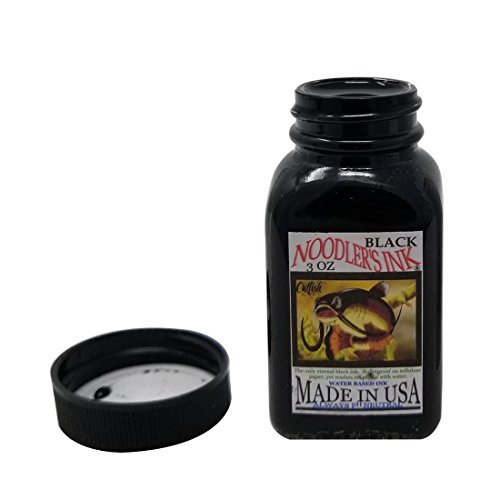 Noodler's Black, 3 oz A dye that bonds to paper fibers, so once it is dry the writing stays put even when the page does not. | Writing that has to survive water | $18.50 · View on Amazon #ad Price as of October 21, 2026. How this is funded |
| 6 |  J. Herbin Perle Noire, 30 ml A dry-writing black in a bottle small enough that a wrong guess costs almost nothing. | A small bottle to try before committing | $15.13 · View on Amazon #ad Price as of October 21, 2026. How this is funded |
| 7 |  Platinum Carbon Black, 60 ml A true pigment ink: the blackest line you can get out of a fountain pen, and permanent once dry. | Line work and archival notes |
1. The safest first bottle
Waterman Serenity Blue, 50 ml
The ink most often recommended as a first bottle because it is well behaved on ordinary paper and washes out of a pen easily.
A first bottle should be forgiving in two ways: it should behave on the cheap paper you already own, and it should rinse out without a fight when you want to change color. Serenity Blue is chosen for both.
It is a straightforward dye ink with no shimmer, no pigment and no unusual additives. That is exactly what you want while you are still learning which problems are the pen, which are the ink and which are the paper.
Waterman does not publish a drying time or a water-resistance figure for it, and neither does anyone else selling it, so we do not quote one.
| Format | 50 ml bottleSource: Waterman Serenity Blue (retail listing, read 2026-09-01) |
|---|---|
| Type | Dye-based, for refillable fountain pensSource: Waterman Serenity Blue (retail listing, read 2026-09-01) |
| Published drying time | Not published |
| Published water resistance | Not published |
What it does well
- Easy to flush out of a pen when changing colors
- Standard dye ink with no unusual additives to complicate diagnosis
- Widely stocked, so it is easy to replace
What it does not
- Not water resistant — a wet page is a lost page
- The color is deliberately unremarkable
- No published performance figures of any kind
Skip this if you need writing that survives water, or if you want the ink itself to be the interesting part of the setup.
2. Thin, absorbent paper
Pelikan 4001 Royal Blue, 62.5 ml
A dry-writing classic that lays down less ink than most, which is exactly what cheap paper needs.
A dry ink is not a defect. Less ink leaving the nib per centimeter of line means less ink for absorbent paper to wick sideways, which is why a dry ink on bad paper often looks sharper than a wet ink on good paper.
4001 is the reference point for that behavior. If you are stuck writing on photocopier paper or a school notebook, this is the pairing that has the best chance of staying crisp.
The trade is on good paper, where a dry ink can feel scratchy and looks thin next to something more saturated.
| Format | 62.5 ml bottleSource: Pelikan 4001 Royal Blue (retail listing, read 2026-09-01) |
|---|---|
| Range | 4001, Pelikan's long-running everyday ink lineSource: Pelikan 4001 Royal Blue (retail listing, read 2026-09-01) |
| Published drying time | Not published |
| Published water resistance | Not published |
What it does well
- Runs dry, which suits thin and absorbent paper
- Large bottle for the money
- Long-established formula that is easy to replace anywhere
What it does not
- Can feel scratchy in an already-dry pen
- Color is pale next to modern saturated inks
- No published figures for drying or water resistance
Skip this if your pen already writes dry — pairing a dry ink with a dry nib is how people conclude they hate fountain pens.
3. The first bottle worth being excited about
Pilot Iroshizuku Kon-peki, 50 ml
A deep azure blue that flows generously and shades from pale to dark within a single stroke on good paper.
#ad Price as of October 21, 2026. How this is funded
Iroshizuku is where most people discover that ink can be interesting. Kon-peki shades — the same stroke goes light where the ink pooled less and dark where it pooled more — and that variation is what makes handwriting look considered rather than printed.
It is a wet ink. On the 70 gsm paper in a supermarket notebook it will show through, and on the worst paper it will bleed. Pair it with 90 gsm or better and it behaves.
It costs several times what a bottle of everyday blue costs, and it will last you a year of daily writing regardless.
| Format | 50 ml bottleSource: Pilot Iroshizuku Kon-peki (retail listing, read 2026-09-01) |
|---|---|
| Color | Kon-peki, deep azure blueSource: Pilot Iroshizuku Kon-peki (retail listing, read 2026-09-01) |
| Behavior noted in the listing | Shading and sheen, most visible with broader nibsSource: Pilot Iroshizuku Kon-peki (retail listing, read 2026-09-01) |
| Published drying time | Not published |
What it does well
- Genuine shading that rewards good paper
- Flows generously in dry-writing nibs
- One bottle lasts a very long time
What it does not
- Wet flow means bleed-through on thin paper
- Several times the price of an everyday blue
- Not water resistant
Skip this if the paper you actually write on is thin office stock — a wet ink on absorbent paper wastes the ink and ruins the page.
4. The cheapest way into interesting color
Diamine Sherwood Green, 80 ml
A large bottle of well-mannered dye ink from the range that makes color experimentation affordable.
#ad Price as of October 21, 2026. How this is funded
Diamine's proposition is volume for money. An 80 ml bottle is enough ink to fill a pen every week for a couple of years, at a price closer to a small bottle from a premium brand.
The range behaves like a standard dye ink should: reasonable flow, reasonable drying, no shimmer particles or pigment to complicate cleaning.
Sherwood Green is a dark, readable green rather than a bright one, which makes it usable for actual work rather than only for decoration.
| Format | 80 ml bottleSource: Diamine Sherwood Green 80 ml (retail listing, read 2026-09-01) |
|---|---|
| Range | Diamine's standard dye range, sold in dozens of colors at the same sizeSource: Diamine Ancient Copper 80 ml (retail listing, read 2026-09-01) |
| Published drying time | Not published |
| Published water resistance | Not published |
What it does well
- Large bottle at a low price
- Huge color range at the same size and price
- Standard dye behavior — nothing unusual to manage
What it does not
- No published performance data at all
- Not water resistant
- Color consistency across the range varies more than premium brands
Skip this if you want your first bottle to be a safe, conventional blue or black — start there and come back for color.
5. Writing that has to survive water
Noodler's Black, 3 oz
A dye that bonds to paper fibers, so once it is dry the writing stays put even when the page does not.
#ad Price as of October 21, 2026. How this is funded
The reason to keep a bottle of this is not the color. It is that a signed document, an address on an envelope or a note left on a windowsill survives contact with water, which ordinary dye inks do not.
Because the dye bonds to the paper rather than sitting on it, it also tends to feather less on cheap stock than its wetness would suggest.
The trade-off is cleaning. Inks that bond to cellulose also bond to the inside of a pen, so flush more often and do not leave it sitting in a pen you plan to ignore for a month.
| Format | 3 oz bottleSource: Noodler's Black (retail listing, read 2026-09-01) |
|---|---|
| Type | Waterproof once dried; the maker describes the dye as bonding to celluloseSource: Noodler's Black (retail listing, read 2026-09-01) |
| Claimed behavior | Feathering-resistant and quick-dryingThe maker's own claim on the listing. We have not tested it.Source: Noodler's Black (retail listing, read 2026-09-01) |
| Published drying time in seconds | Not published |
What it does well
- Water resistance that ordinary dye inks cannot offer
- Large bottle
- Copes better than most wet inks on ordinary paper
What it does not
- Harder to flush out than a standard dye ink
- Not for a pen you will leave unused for long periods
- No published drying figure despite the quick-drying claim
Skip this if you swap colors often or leave pens inked for weeks — a bonding ink punishes both habits.
6. A small bottle to try before committing
J. Herbin Perle Noire, 30 ml
A dry-writing black in a bottle small enough that a wrong guess costs almost nothing.
#ad Price as of October 21, 2026. How this is funded
Thirty milliliters is a sensible amount of ink for someone with one pen. It is months of writing, and it does not commit you to a color for years.
Perle Noire runs on the dry side for a black, which makes it a better companion for wet nibs and thin paper than most blacks are.
The same ink is available in cartridges, which is unusually convenient if you want to carry the color rather than only use it at a desk.
| Format | 30 ml bottleSource: J. Herbin Perle Noire 30 ml (retail listing, read 2026-09-01) |
|---|---|
| Also sold as | A tin of six international standard cartridgesSource: J. Herbin Perle Noire cartridges (retail listing, read 2026-09-01) |
| Published drying time | Not published |
| Published water resistance | Not published |
What it does well
- Small bottle, small commitment
- Runs dry, which helps on thin paper
- Available in international standard cartridges too
What it does not
- Not water resistant
- Less saturated than a pigment black
- No published figures
Skip this if you want maximum blackness on the page — a pigment ink is a different order of dark.
7. Line work and archival notes
Platinum Carbon Black, 60 ml
A true pigment ink: the blackest line you can get out of a fountain pen, and permanent once dry.
Pigment ink suspends solid particles rather than dissolving a dye, which is why it is opaque, why it is permanent, and why it will clog a pen left to dry out.
For drawing, for signatures, and for anything you want legible in twenty years, nothing else in a fountain pen comes close.
It demands discipline. Do not leave it in a pen you are not using, and flush thoroughly when you change ink.
| Format | 60 ml bottleSource: Platinum Carbon Black (retail listing, read 2026-09-01) |
|---|---|
| Type | Pigment ink (carbon), not a dyeSource: Platinum Carbon Black (retail listing, read 2026-09-01) |
| Also sold as | Platinum Carbon cartridges, for pens that take themSource: Platinum Carbon ink cartridges (retail listing, read 2026-09-01) |
| Published drying time | Not published |
What it does well
- Genuinely black and genuinely permanent
- Excellent for ink drawing over watercolor
- Available as cartridges as well as a bottle
What it does not
- Will clog a pen that is left to dry
- Needs more frequent cleaning than any dye ink
- Not a good match for a pen you use once a fortnight
Skip this if your pen sits unused for weeks at a time — a dried pigment ink is a much bigger problem than a dried dye ink.
How to read a range you have not tried
Four properties decide how an ink behaves, and only one of them appears on the bottle. The ink hub works through them in detail; the short form is:
- Wetness — how much ink leaves the nib. Wet inks feel smooth and bleed on cheap paper; dry inks stay sharp and can feel scratchy in a dry nib.
- Drying time — mostly a function of your paper, but formulation matters, and it decides whether a left-handed writer smudges.
- Water resistance — a chemistry question, covered on waterproof ink.
- How easily it flushes out — the most ignored property, and the one that decides how freely you can change color.
A maker is usually consistent across their standard range on the first and fourth of those, which is why range-level advice works at all.
What none of them publish
Drying times in seconds. Water-resistance ratings. Lightfastness. Saturation. Flow rate. Across every maker on this page, the published specification amounts to a color name and a volume.
That is why this site does not print those figures, and why a page ranking inks on numeric performance would be making them up. What we can do is tell you the chemistry, the format, what the maker claims in its own words, and where established publishers agree.
Ranges we have deliberately not recommended
- Shimmer inks, from any maker. Suspended metallic particles settle in the bottle and in the feed, need agitation before every fill, and demand far more cleaning. They are a pleasure purchase for someone with a pen to spare, not a range to start in.
- Iron gall inks. Genuinely permanent and genuinely capable of corroding a nib left standing. Real, and not a beginner range.
- Scented inks. No performance argument either way; buy them if you want them.
- Art and calligraphy inks. Not fountain pen ink at all — India ink and dip-pen ink will set solid in a feed.
How many bottles you actually need
Fewer than the shelf suggests. A 50 ml bottle fills a typical converter well over fifty times, and a converter of ink is several days of ordinary writing — so one bottle is realiztically a year or more.
For most people the complete answer is two: an everyday color you enjoy, and a pigment black for the handful of things that need to survive water. A third bottle is a hobby rather than a need, which is the point at which Diamine's volume and Iroshizuku's shading start to matter.
If you are buying your very first bottle, ignore all of this and buy something ordinary — inks for beginners explains why a boring first ink is a diagnostic decision rather than a lack of ambition. And if that first bottle is going to be black, the black ink comparison separates them on the properties that actually differ. For the first color most people try after blue and black, the green ink roundup sorts those by how loud they are, and the red ink roundup covers the one color that usually has a job attached.
Questions people actually ask
What is the best fountain pen ink brand?
It depends on what you need. Waterman for a safe first bottle, Pelikan for thin paper, Pilot's Iroshizuku for shading on good paper, Diamine for volume and color range, and Platinum or Sailor for pigment permanence.
Which ink brand is best value?
Diamine, on volume. The standard bottle is 80 ml, which is more ink than most people use in two years, at a price closer to a small bottle from a premium maker.
Do ink brands publish performance specifications?
Essentially none of them do. Across every maker on this page the published specification is a color name and a volume — no drying time, no water-resistance rating, no lightfastness. We mark those rows not published rather than estimating.
Can I mix inks from different brands?
Within one maker's dye range it is usually harmless. Across brands it risks precipitating solids that block a feed, and there is no upside worth that while you are starting out.
How many bottles of ink do I need?
Two covers most people: an everyday color and a pigment black for anything that must survive water. A 50 ml bottle is realiztically a year or more of writing.
Sources
- Waterman Serenity Blue (retail listing, read 2026-09-01)
- Pelikan 4001 Royal Blue (retail listing, read 2026-09-01)
- Pilot Iroshizuku Kon-peki (retail listing, read 2026-09-01)
- Diamine Sherwood Green 80 ml (retail listing, read 2026-09-01)
- Noodler's Black (retail listing, read 2026-09-01)
- J. Herbin Perle Noire 30 ml (retail listing, read 2026-09-01)
- Platinum Carbon Black (retail listing, read 2026-09-01)
- The Goulet Pen Company
- edjelley.com